Stop Tool Sprawl: How to Consolidate Your Sales Tech Stack
Why should businesses consolidate their sales tech stack?
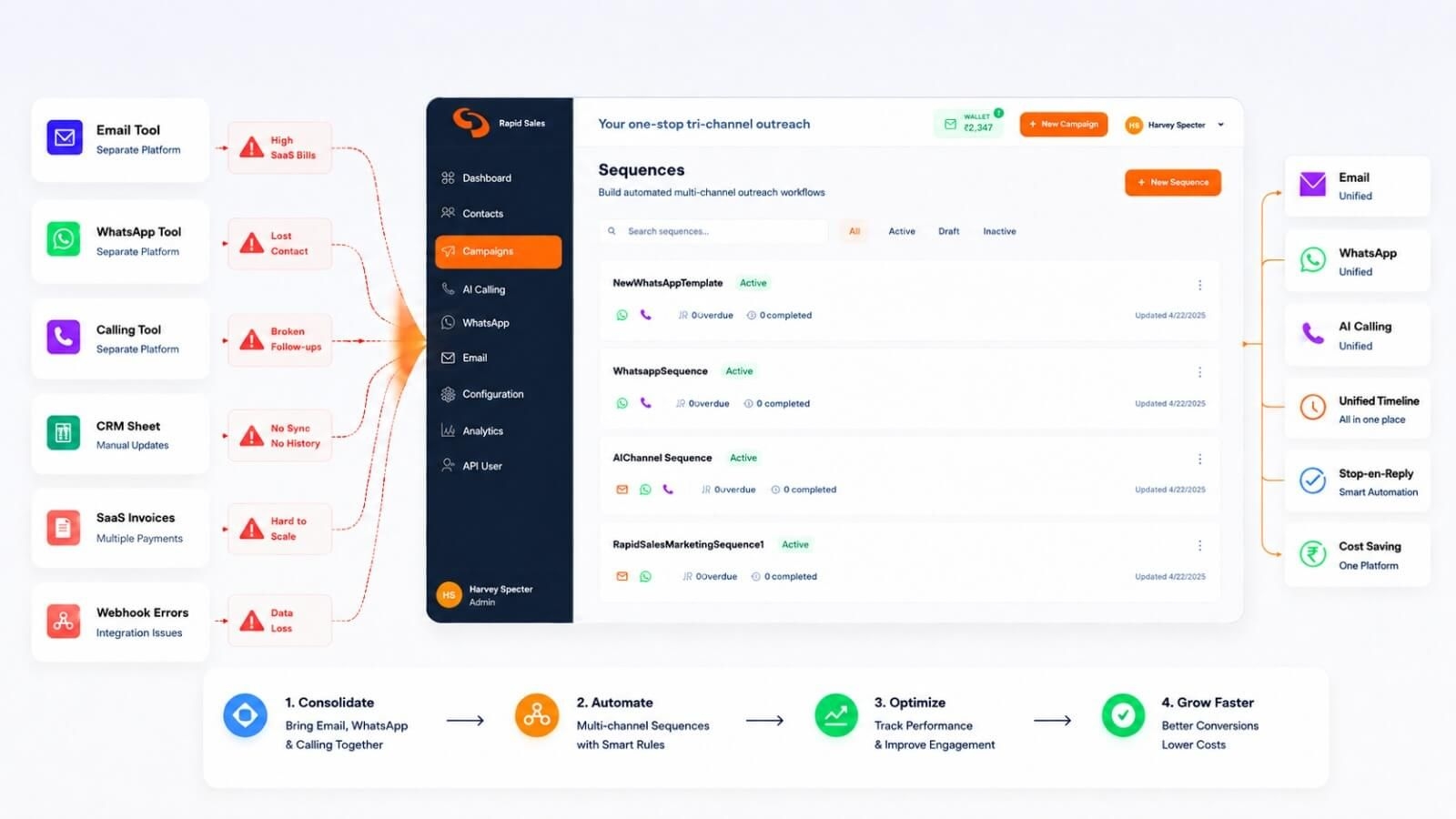
Businesses should consolidate their sales tech stack to eliminate software tool sprawl, which inflates monthly SaaS costs and creates massive data silos. By replacing standalone tools—such as isolated email sequencers, third-party WhatsApp bots, and legacy cloud dialers—with a single, unified sales communication platform, companies drastically reduce subscription fees, eliminate fragile third-party integrations, and provide their sales team with one centralized dashboard for all customer interactions.
For the past decade, the dominant philosophy in B2B software was "best-in-breed." If your sales team had a problem, the solution was to buy a highly specialized app to fix it.
Need to send cold emails? Buy an email sequencer. Need to text clients? Buy a WhatsApp API tool. Need to make calls? Buy a cloud telephony dialer. Need somewhere to store it all? Buy a traditional CRM database.
Fast forward to 2026, and this philosophy has created a crisis for Revenue Operations (RevOps) teams. It is called Software Tool Sprawl. Your sales representatives are drowning in a sea of browser tabs, spending more time copy-pasting data between apps than actually selling. Worse, your company is paying thousands of dollars a month for software that refuses to communicate natively.
To scale efficiently, businesses are abandoning fragmented tools. It is time to audit your subscriptions and consolidate your sales tech stack.
What is Software Tool Sprawl?
Software tool sprawl occurs when an organization adopts an excessive amount of overlapping Software as a Service (SaaS) applications without a centralized strategy. In the sales department, this usually manifests as a "Franken-stack"—a monster made of disconnected communication tools, tracking dashboards, and note-taking apps duct-taped together.
The 3 Hidden Costs of a Fragmented Tech Stack
Founders often hold onto their fragmented tools because they fear the perceived pain of migrating to a new system. What they fail to realize is the severe, ongoing damage their current setup is causing to their bottom line.
1. The Financial Drain (Duplicate Seats)
SaaS tools charge per user. If you have 15 sales representatives, you are paying for 15 CRM licenses, 15 email sequencer licenses, 15 telephony seats, and 15 WhatsApp platform seats. You are essentially paying four times for the exact same core objective: talking to a prospect. This bloat artificially inflates your Customer Acquisition Cost (CAC) and shrinks your profit margins.
2. Operational Friction (Context Switching)
Psychologists refer to "context switching" as the mental energy lost when jumping between different tasks or interfaces. If a sales rep has to check their email app, look at their WhatsApp web browser, and then search the CRM to understand the status of a deal, they lose crucial momentum. This friction leads to slower lead response times and poor CRM adoption rates.
3. Data Silos and Broken Webhooks
When tools don't share a native database, data gets siloed. To fix this, IT teams try to stitch the tools together using third-party webhooks (like Zapier).
The reality of the "Franken-Stack": Webhooks are fragile. When an API updates, a password changes, or a server lags, the integration silently breaks. Your email tool won't know that the prospect replied on WhatsApp yesterday, and it will send a scheduled, robotic follow-up that embarrasses your brand.
The Strategic Pivot: The Unified Sales Platform
The antidote to tool sprawl is Vendor Consolidation. Instead of buying separate applications for every communication channel, modern RevOps leaders are migrating to Unified Sales Communication Platforms.
A unified platform is built from the ground up with native architecture. Email, WhatsApp, conversational AI voice calling, and the core CRM database are not separate plugins; they are core features living under the exact same code base.
3 Immediate Benefits of Consolidating Your Tools
When you replace your fragmented apps with a unified system, your sales operations experience an immediate transformation.
1. The Single Chronological Timeline
Instead of hunting across three different apps, your sales rep clicks on a prospect's name and sees a flawless, chronological timeline. They see the AI voice call transcript from Monday, the WhatsApp chat log from Tuesday, and the email proposal sent on Wednesday, all seamlessly stacked on one screen. Total context, zero effort.
2. True Cross-Channel Coordination
Because the unified platform acts as the brain for all channels, it possesses perfect visibility. If you have a multi-channel sequence running, and the prospect replies via WhatsApp, the platform's native "Stop-on-Reply" engine instantly pauses any future automated emails. Your outreach is always coordinated, protecting your brand's reputation.
3. Massive SaaS Cost Reduction
By consolidating, you cancel three or four separate SaaS invoices and replace them with one predictable platform fee. High-growth B2B teams frequently cut their sales software expenditure by 40% to 50% simply by auditing their stack and adopting a unified CRM solution.
Unify Your Operations with Rapid Sales
You don't need more software. You need better software.
Rapid Sales is the ultimate unified sales communication platform, specifically engineered to eliminate software tool sprawl. We allow you to confidently cancel your standalone email sequencers, your clunky legacy dialers, and your third-party WhatsApp bots.
By bringing native WhatsApp automation, multi-stage professional email sequencing, and conversational AI voice calling into a single, intuitive dashboard, Rapid Sales streamlines your entire outbound operation. We lower your SaaS overhead, eliminate data entry for your reps, and provide absolute clarity over your pipeline.
Clear the software clutter. Consolidate tools with Rapid Sales and experience the power of a truly unified sales engine.