WhatsApp Automation vs. Email Marketing: Which is Better for Sales?
Which is better for B2B sales: WhatsApp or Email?
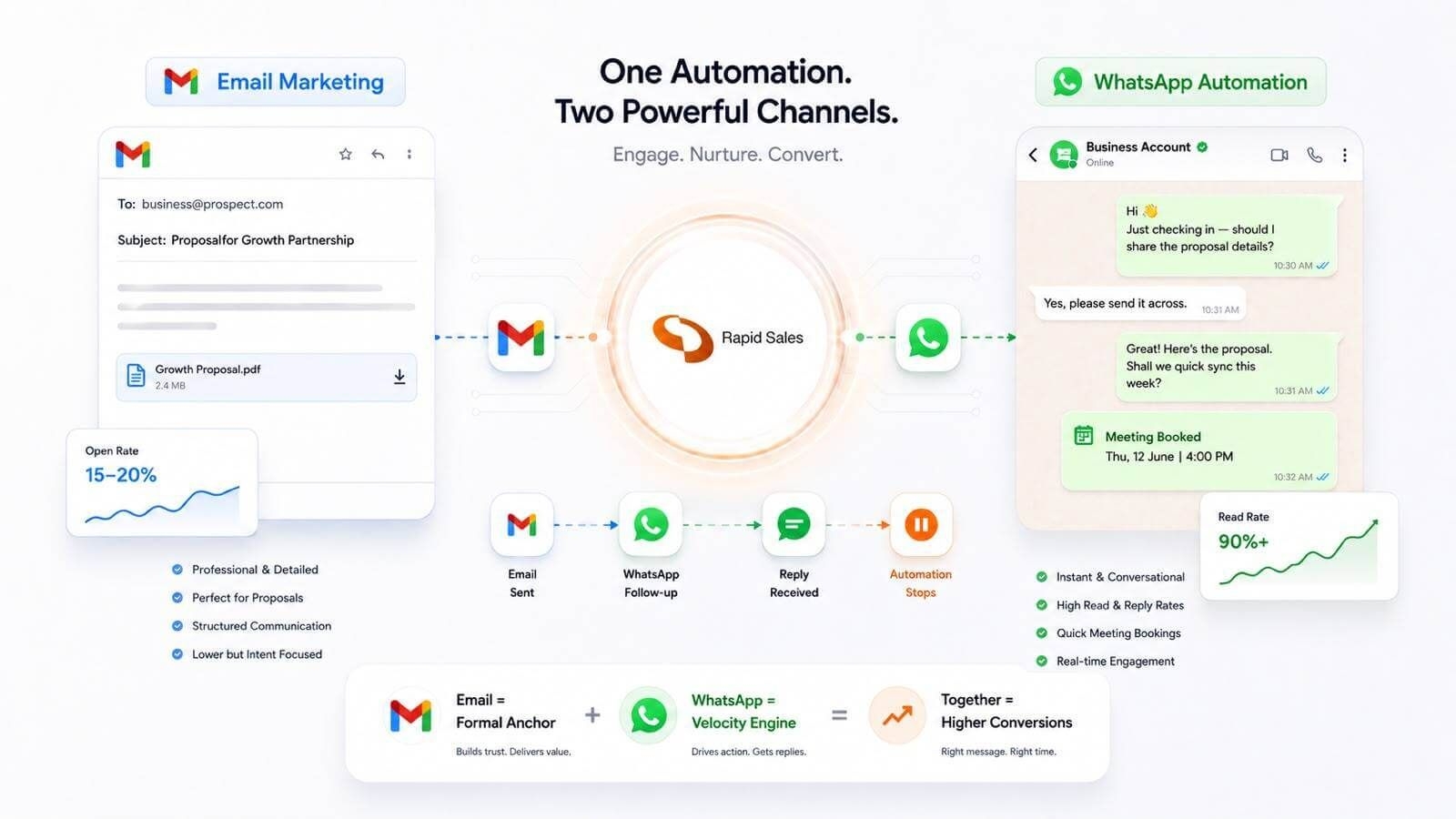
When comparing WhatsApp automation to email marketing, neither channel is universally "better." Email is the formal system of record, best used for delivering complex proposals, contracts, and long-form case studies. WhatsApp is a high-velocity channel, best used for rapid appointment scheduling, fast nudges, and urgent reminders. Because buyers have different communication preferences, the most effective sales strategy involves unifying both channels into a single, automated multi-channel sequence.
If you spend enough time researching B2B sales strategies, you will inevitably run into a polarized debate. On one side, growth marketers will tell you that "Email is dead" and that text messaging is the only future. On the other side, traditional sales directors will warn you that sending business messages on WhatsApp is "invasive and unprofessional."
Both of these perspectives are fundamentally flawed.
When you ask, “Which is better: WhatsApp or Email?” you are asking the wrong question. It is the equivalent of a carpenter asking, “Which is better: a hammer or a screwdriver?” They are different tools designed to perform entirely different jobs within the same buyer journey.
To maximize your revenue, you must understand the distinct strengths and weaknesses of both channels, and more importantly, how to combine them.
The State of Outbound Sales in 2026
The reason this debate exists is due to the massive decline in email performance. Ten years ago, a B2B cold email campaign could easily generate a 40% open rate. Today, due to aggressive spam filters and severe inbox fatigue, average outbound open rates hover around 15% to 20%.
Sales teams became desperate for a channel where buyers actually read the messages, leading to the explosive rise of the WhatsApp Business API. However, teams that abandoned email entirely and switched 100% of their operations to WhatsApp quickly realized that texting a 10-page legal contract to a CEO is highly ineffective.
The Case for Email Marketing: The Formal Anchor
Email is the legacy backbone of business communication. It is asynchronous, meaning the recipient does not feel pressured to reply immediately.
Pros of Email
- High Capacity for Value: Email is perfect for delivering rich, heavy content. It is the ideal channel for sending detailed PDF proposals, lengthy case studies, secure payment portals, and calendar invites.
- Professional Expectations: Buyers expect B2B pitches and formal documentation to arrive via email. It sets a professional tone for complex, high-ticket sales.
- Searchability: A buyer can easily search their email inbox six months later to find your pricing proposal.
Cons of Email
- Terrible Open Rates: The primary flaw of email is visibility. If a buyer receives 100 emails a day, your polite follow-up is easily buried or sent to the "Promotions" folder.
- Slow Velocity: Email conversations can drag on for weeks, artificially extending your sales cycle.
The Case for WhatsApp Automation: The Velocity Engine
WhatsApp is a conversational medium. When an executive receives a WhatsApp message, their brain processes it with the same urgency as a text from a friend or colleague.
Pros of WhatsApp
- Unmatched Visibility: WhatsApp boasts open rates exceeding 90%. If you send a message, you can be almost mathematically certain the prospect will look at it.
- Frictionless Velocity: WhatsApp removes formality. A prospect can reply with a simple "Yes, let's meet tomorrow" while sitting in an airport lounge, significantly shortening the sales cycle.
- Instant Nudges: It is the perfect channel for checking in on stalled deals, sending automated meeting reminders, or delivering direct calendar booking links.
Cons of WhatsApp
- Compliance and Restrictions: Meta heavily regulates outbound WhatsApp marketing. You must use pre-approved templates for outbound messages, and blasting generic promotional spam will get your account banned.
- Inappropriate for Heavy Documents: Nobody wants to read a 500-word corporate proposal on a 6-inch mobile screen.
The False Dichotomy: Why Choosing One is a Trap
If you rely solely on email, your sales pipeline will choke due to low visibility. If you rely solely on WhatsApp, you will struggle to deliver formal value and risk crossing the line into spam.
The ultimate B2B sales strategy is Multi-Channel Automation. You must use both tools in a coordinated dance.
The Ultimate Strategy: Combining Both Channels
To maximize conversions, modern Revenue Operations (RevOps) teams build automated sequences that pass the buyer back and forth between the two channels seamlessly.
The Multi-Channel Handoff
Instead of sending three "just checking in" emails, a combined sequence leverages the strengths of both mediums:
- Step 1 (Email): Send the heavy, formal pricing proposal containing the PDF breakdown and ROI calculator.
- Step 2 (WhatsApp): Two days later, trigger a high-velocity text nudge: "Hi David, I sent the pricing proposal over to your email on Tuesday. Let me know if you need me to clarify any of the tier features!"
You use the email to deliver the value, and you use the WhatsApp message to guarantee they look at the email.
The Safety Net: Cross-Channel Stop-on-Reply
The only way this combined strategy works is if your software is unified. If you use a standalone email tool and a separate WhatsApp app, you risk sending robotic messages (e.g., your email tool sends a reminder to a client who already replied to you on WhatsApp).
To execute this professionally, you must use a CRM with a cross-channel Stop-on-Reply engine. When a prospect engages on either channel, the system instantly pauses all future automated messages, allowing the human sales rep to take over.
Unify Your Outreach with Rapid Sales
The debate is over. Stop choosing between email and WhatsApp, and start using them together.
Rapid Sales is the premier unified sales communication platform built specifically to end the fragmentation of B2B sales. We natively combine multi-stage email sequencing with enterprise-grade WhatsApp Business automation in one single, intuitive dashboard.
Our chronological timeline tracks every email open and WhatsApp reply in one place, while our intelligent stop-on-reply logic ensures your multi-channel cadences are always coordinated, compliant, and highly professional.
Don't leave your sales to chance. Combine WhatsApp and Email with Rapid Sales and build an automated pipeline that actually gets replies.