WhatsApp Business Automation: A Blueprint for B2B Sales Teams
How do you use WhatsApp business automation for B2B sales?
B2B sales teams use WhatsApp business automation by integrating the WhatsApp Business API directly into a unified sales CRM. Instead of sending bulk promotional blasts, B2B teams use automation to trigger highly contextual, conversational messages—such as instant inbound lead acknowledgments, automated calendar links after a demo, and polite nudges for stalled contracts. This approach bypasses crowded email inboxes, leveraging WhatsApp's 90%+ open rates to accelerate the sales cycle.
For years, Business-to-Business (B2B) sales teams operated under a strict unwritten rule: Email is for business, text messages are for friends.
In 2026, that rule is completely dead.
As standard B2B cold email open rates plummet into the single digits and spam filters become increasingly aggressive, buyers have signaled a clear preference for fast, frictionless communication. They want to communicate on WhatsApp.
However, many B2B sales directors are hesitant to adopt WhatsApp because they associate it with direct-to-consumer (D2C) brands sending spammy coupon codes. If used incorrectly, WhatsApp automation can annoy high-value prospects. But when executed with a strategic, conversational blueprint, it becomes the most powerful pipeline-accelerating tool in your tech stack.
The Difference Between D2C Blasts and B2B Conversational Sales
To succeed on WhatsApp, B2B companies must understand the platform's context.
A D2C e-commerce brand plays a volume game. They can blast a 20% off discount code to 10,000 past customers, expecting a 2% conversion rate.
B2B sales is a relationship game. If an agency or a custom software firm blasts a generic promotional poster to 500 decision-makers, they will instantly receive high block rates, and Meta will likely restrict their WhatsApp Business account.
B2B WhatsApp automation must focus on Conversational Sales. Automation should not be used to pitch blindly; it should be used to trigger highly relevant, text-based follow-ups based on specific actions the buyer just took.
Why Sales Teams Must Adopt the WhatsApp Business API
Many sales reps already use WhatsApp to text prospects, but they do it using the standard, free WhatsApp Business app on their personal phones. This is a massive operational risk.
Eliminating "Shadow IT" (Personal Phones)
When reps use personal WhatsApp accounts, your company has zero visibility into the sales communication. If a rep leaves the company, they take the client's chat history with them. Upgrading to the WhatsApp Business API routes all chats through a central CRM, ensuring company ownership of the data.
Unlocking True Automation
The free WhatsApp app only allows for basic "Away Messages." The API allows you to build multi-stage sequences, trigger texts based on website forms, and automatically stop messages if a prospect replies.
The B2B WhatsApp Automation Blueprint (3 Use Cases)
Here is the exact blueprint high-growth B2B teams use to implement WhatsApp automation effectively and professionally:
Use Case 1: The Instant Inbound Qualifier
When a prospect fills out a "Contact Us" or "Request Demo" form on your website, they expect a fast response.
- The Automation: Instead of sending a generic automated email that gets buried, trigger an automated WhatsApp message within 30 seconds.
- The Template: "Hi [Name], thanks for reaching out to [Company Name]. I'm reviewing your request now. In the meantime, you can easily grab a time on my calendar for a quick chat here: [Calendar Link]."
Use Case 2: The Post-Demo Nudge
You just finished a great 45-minute software demo, and you sent the pricing proposal via email. Three days go by with no response.
- The Automation: Sending a fourth email is likely to be ignored. Trigger an automated WhatsApp nudge designed to be low-friction.
- The Template: "Hi [Name], I sent over that pricing proposal on Tuesday. Let me know if you had any trouble opening the PDF or if you have any quick questions I can answer here!"
Use Case 3: Stalled Deal Re-Engagement
Deals naturally stall when executives get busy.
- The Automation: Create a "Breakup" sequence for leads that have been unresponsive for 14 days.
- The Template: "Hi [Name], I haven't heard back, so I'll assume solving [Pain Point] isn't a priority for this quarter. I'll pause my outreach, but feel free to text me here whenever you are ready to pick this back up." (This leverages loss aversion and frequently triggers immediate replies).
Navigating Meta’s Restrictions: Why You Need a Unified CRM
You cannot simply plug WhatsApp into any software and start texting. Meta strictly governs outbound marketing through the WhatsApp Business API to protect users from spam.
Before you can send an automated outbound message to a prospect who hasn't messaged you first, you must use a pre-approved "Template." If your templates are too promotional, Meta will reject them.
This is why B2B teams cannot rely on basic chat apps. You need a unified sales platform built specifically to manage Meta's compliance, template approvals, and rate limits smoothly, ensuring your team never experiences downtime.
The Golden Rule: Combining WhatsApp with Email
The most important rule of B2B WhatsApp automation is that it cannot exist in a vacuum.
WhatsApp is brilliant for high-velocity nudges, but it is terrible for sending formal 10-page contracts or heavy legal documentation. Email is still required.
The ultimate B2B sales sequence combines both. You send the heavy proposal via Email, and you use automated WhatsApp messages to alert the prospect that the email is waiting for them. To execute this without sending duplicate messages, your CRM must have a cross-channel "stop-on-reply" engine that pauses all automation the moment the prospect engages on either channel.
Automate WhatsApp with Rapid Sales
Building a sophisticated, compliant WhatsApp sales engine doesn't have to be complicated.
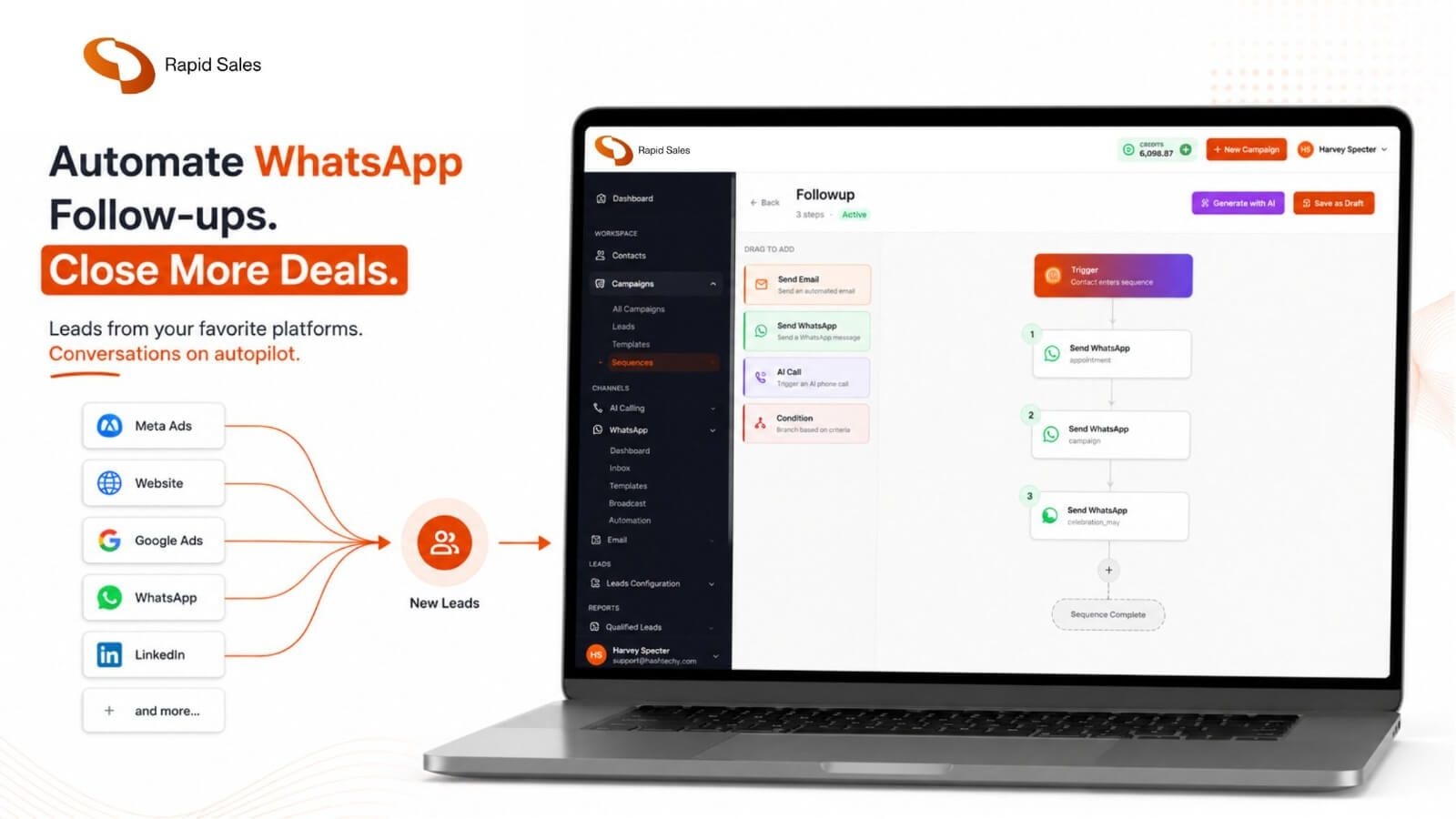
Rapid Sales is a comprehensive communication management system that brings the power of the WhatsApp Business API directly into your sales team's hands. We eliminate the need for fragmented tools and personal phones by centralizing WhatsApp, formal email, and AI voice calling into a single, unified chronological dashboard.
With Rapid Sales, you can easily deploy pre-approved B2B WhatsApp templates, build automated multi-channel sequences, and rely on our intelligent stop-on-reply logic to ensure your sales outreach is always professional, fast, and highly effective.
Stop letting your B2B leads get lost in the spam folder. Automate WhatsApp with Rapid Sales and start engaging your buyers where they actually respond.