How to Track Sales Campaign ROI Across WhatsApp and Email
How do you track sales campaign ROI across multiple channels?
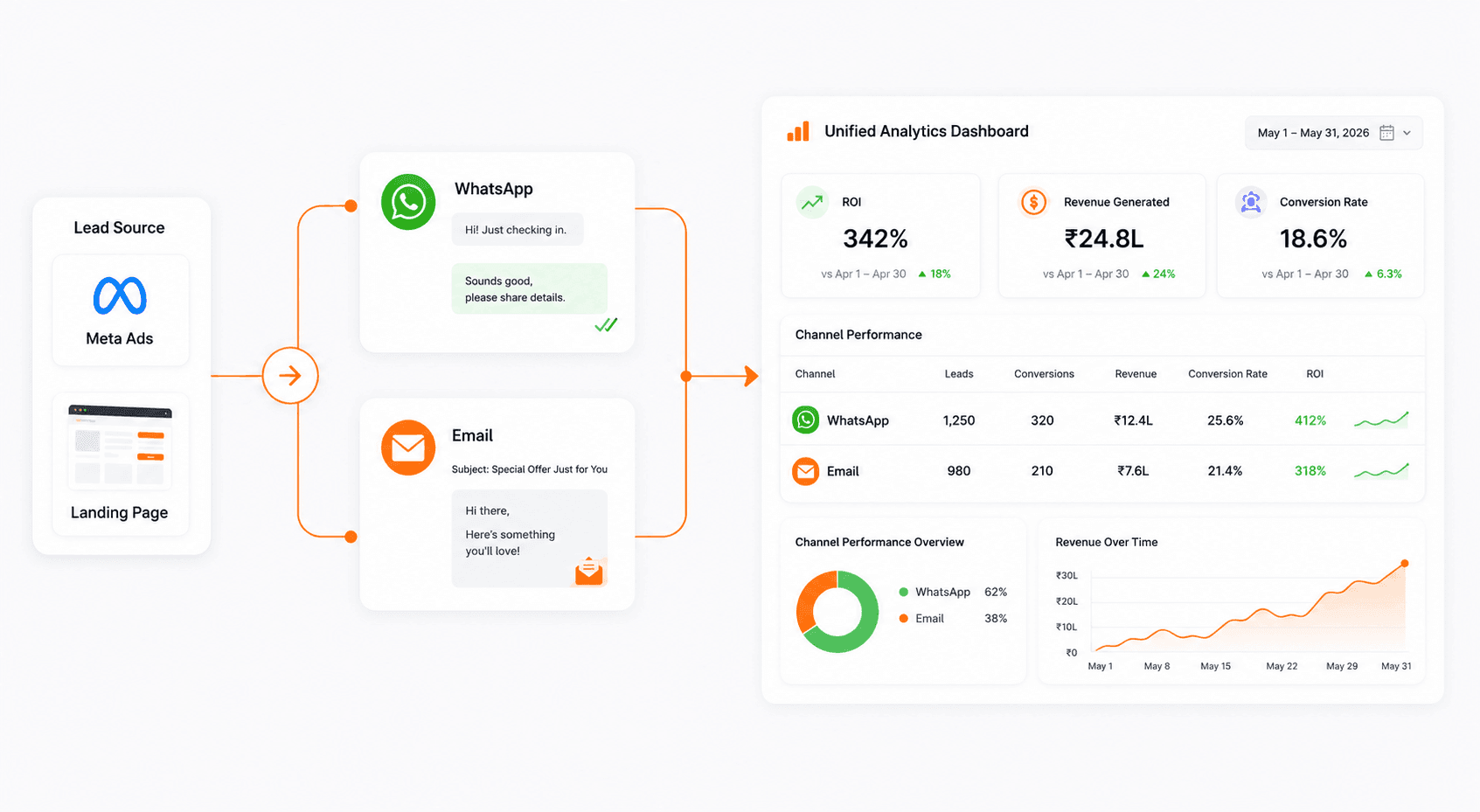
Tracking sales campaign Return on Investment (ROI) across email and WhatsApp requires eliminating data silos. Businesses must transition from fragmented communication tools to a unified sales platform. A unified CRM automatically tags the originating lead source (like a specific Google Ad), records every subsequent email open and WhatsApp reply on a chronological timeline, and ties the final closed revenue directly to the initial campaign, providing flawless multi-channel attribution.
In modern B2B organizations, the war between sales and marketing is usually fought over a single spreadsheet.
Marketing claims a campaign was a massive success because it generated 200 leads. Sales claims the campaign was a failure because only five deals closed. When leadership asks why those specific five deals closed, nobody has a definitive answer.
Did the buyer respond to the Day 3 automated email? Did they click the WhatsApp calendar link? Did they engage with an AI voice agent?
When your sales tech stack is fragmented, calculating accurate Return on Investment (ROI) is mathematically impossible. To scale operations efficiently, Revenue Operations (RevOps) leaders must fix their attribution blind spots and learn how to track campaign performance natively across WhatsApp, email, and voice.
The "Attribution Blind Spot" in Modern Sales
An attribution blind spot occurs when a lead is generated on one platform (like a Meta Ad), but the actual sales conversation happens on a private, untracked channel.
For years, outbound sales teams relied heavily on email. Email software has built-in analytics: you can track open rates, click-through rates, and bounce rates. But as buyers transition to high-velocity channels like WhatsApp, those legacy metrics become useless. If a prospect ignores your tracked email but replies to a text message on a sales representative's personal WhatsApp account, your CRM records zero engagement.
When you cannot see the engagement, you cannot measure the ROI of your outreach campaigns.
The Danger of Data Silos (Why Zapier Isn't Enough)
Many businesses attempt to fix this blind spot by purchasing multiple software tools and attempting to stitch them together using third-party webhooks (like Zapier). They buy an email sequencer, a WhatsApp broadcast tool, and a passive CRM database.
This creates rigid data silos.
Disconnected Email Metrics
Your email sequencer can tell you that a prospect opened a message. But it cannot tell you that the exact same prospect just booked a meeting via WhatsApp. To your email reporting dashboard, the campaign looks like a failure because the meeting link in the email wasn't clicked.
The "Dark Social" of WhatsApp
If your sales reps are using personal WhatsApp apps or disconnected third-party WhatsApp bots, the data is entirely trapped. When a $50,000 deal closes, leadership cannot look back at the campaign data to see how many texts were sent to secure the meeting. The data is "dark."
How to Achieve True Multi-Channel Attribution
To accurately track sales campaign ROI, you must measure the entire customer journey from a single point of truth. Here is how modern scaling teams set up their attribution models:
Step 1: Centralize the Source Tagging
Attribution starts at the very top of the funnel. When you launch a campaign (e.g., a "Q3 Product Launch Webinar"), every lead that enters your system via that specific landing page or Meta Ad must be automatically tagged with a Campaign ID in your central CRM.
Step 2: Utilize a Unified Chronological Timeline
You must force your sales team to execute all communication from within the CRM.
By using a unified sales communication platform, every email sent, every WhatsApp message delivered, and every AI voice call completed is logged automatically.
When a manager views the campaign dashboard, they don't see siloed data. They see the complete timel
- Lead Acquired (Meta Ad)
- Day 1: AI Call (Answered)
- Day 2: WhatsApp Message (Replied)
- Day 4: Deal Closed.
Step 3: Track Cross-Channel Engagement Rates
Once communication is unified, you can track sequence efficacy. You might discover that your Q3 campaign generated an 8% reply rate on email, but a massive 42% reply rate on WhatsApp. This data is critical for RevOps teams, allowing them to shift budget and effort toward the channels that actually drive conversations.
Calculating Exact Campaign ROI
With a unified platform, ROI calculation transforms from a guessing game into basic math.
Because the CRM tracks the originating campaign tag, the cost of the campaign, and the final closed revenue value of the deal, the reporting dashboard can generate an exact ROI metric.
Takeaway: A unified CRM allows you to say definitively: "We spent $5,000 on the Q3 Meta campaign. Our automated WhatsApp and Email sequences engaged 80% of those leads, resulting in $45,000 in closed revenue. The campaign ROI is 800%."
Proving Your Value: The Agency and RevOps Advantage
For B2B marketing agencies and internal RevOps leaders, unified tracking is the ultimate defense mechanism.
When a client or a CEO questions the validity of a marketing budget, you no longer have to point to vague metrics like "brand awareness" or "click-through rates." You can pull up the unified tracking dashboard, show them the exact WhatsApp conversations that led to the closed deals, and prove your financial value to the organization.
Unify Your Campaign Tracking with Rapid Sales
You cannot optimize what you cannot measure. If your sales team is operating across disconnected apps, your campaign data is fundamentally broken.
Rapid Sales is designed to eliminate attribution blind spots. As a unified sales communication platform, we automatically track every inbound lead source and log every subsequent email, WhatsApp message, and AI voice call onto a single chronological timeline.
Our advanced analytics dashboards give founders and RevOps leaders crystal-clear visibility into which campaigns are generating leads, which multi-channel sequences are generating replies, and exactly how much revenue each campaign is closing.
Stop guessing what works. Unify campaign tracking with Rapid Sales and start measuring your exact sales ROI today.