Why Fast-Growing Teams are Replacing 3 Tools with 1 Platform
Why should sales teams consolidate their software tools?
Sales teams should consolidate software to eliminate data silos, reduce operational friction, and cut monthly SaaS costs. Instead of paying separately for an email sequencer, a standalone WhatsApp application, and a legacy telecalling dialer, fast-growing teams are migrating to a single Unified Sales Communication Platform. This allows all outreach—text, email, and voice—to execute from one native dashboard, providing a chronological timeline of customer interactions and ensuring seamless cross-channel automation.
Over the last ten years, B2B software companies successfully sold the business world on the idea of the "best-in-breed" tech stack. The philosophy was simple: if you have a highly specific problem, you must buy a highly specific, standalone app to solve it.
While this sounded great in theory, the reality of 2026 is that Revenue Operations (RevOps) teams are drowning in software.
This phenomenon is known as Software Tool Sprawl. Your sales representatives are constantly switching between five different browser tabs. Your data is fragmented. Your IT team is constantly fixing broken integrations. Worst of all, your profit margins are shrinking because you are paying thousands of dollars a month in duplicate software subscription fees.
To scale efficiently, the most successful, fast-growing teams are abandoning the "Franken-Stack" approach and replacing their fragmented tools with a single, unified sales communication platform.
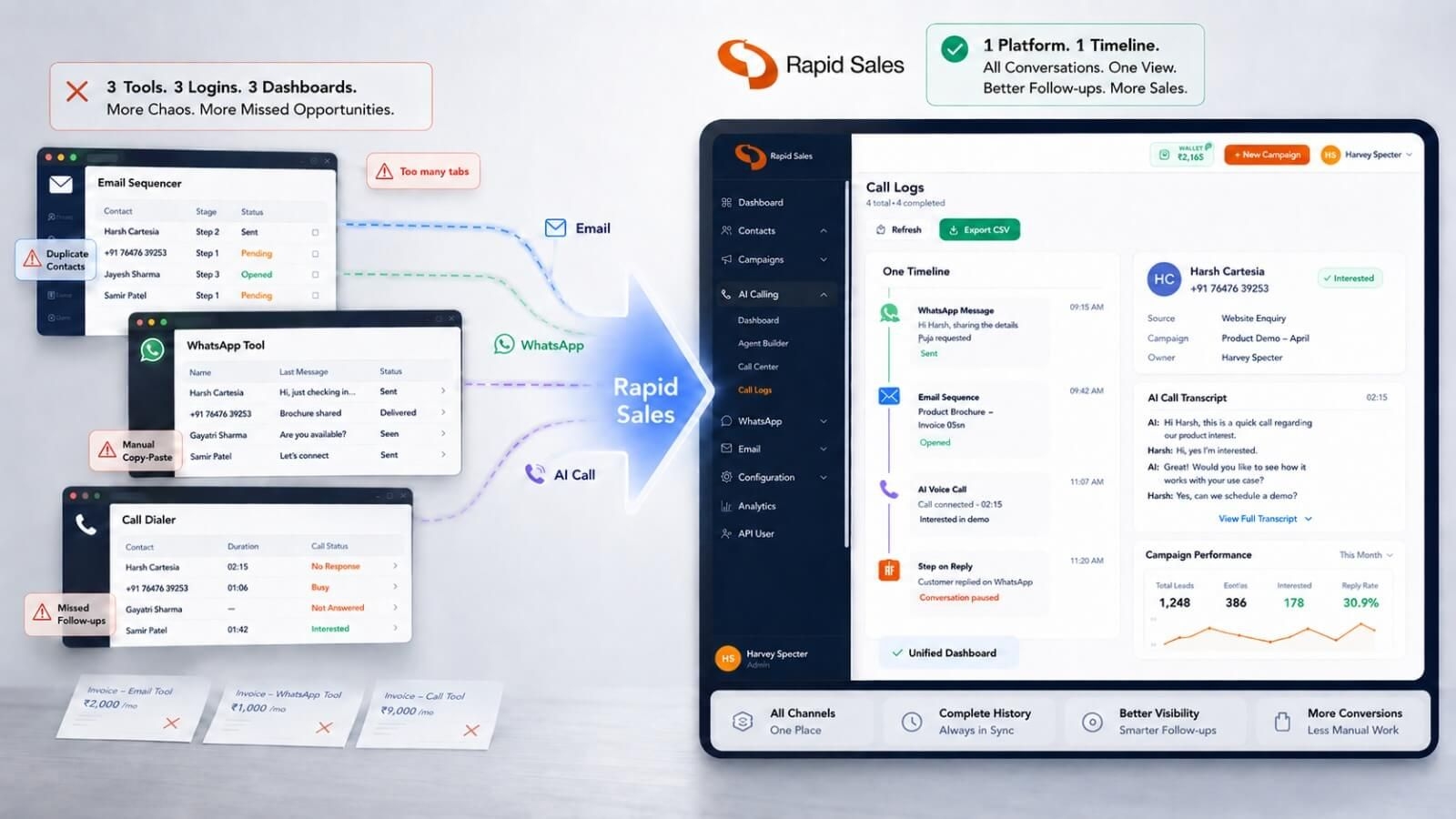
The Disconnected Tech Stack: A 3-Tool Nightmare
To understand why vendor consolidation is happening so rapidly, we have to look at the three standalone tools currently suffocating the average sales floor:
Tool 1: The Email Sequencer
You buy a sophisticated email marketing tool to send automated drip campaigns. It tracks open rates and click-throughs brilliantly, but it has absolutely no idea if a prospect just texted your sales rep on their mobile phone.
Tool 2: The WhatsApp Broadcaster
Because email open rates are dropping, you purchase a third-party WhatsApp Business API tool. Now you can text your clients, but this tool is completely isolated from your email sequencer and your primary CRM database.
Tool 3: The Cold Calling Dialer
You pay for a cloud telephony tool so your reps can make outbound calls. The audio files are stored in the cloud, completely disconnected from the text messages and emails the prospect received earlier that week.
The Hidden Cost of Software Tool Sprawl
When you operate these three tools independently, you suffer from two massive, silent operational costs.
Paying for Duplicate User Seats
Software as a Service (SaaS) platforms charge per user. If you have 20 sales representatives, you are paying for 20 seats on the email tool, 20 seats on the WhatsApp tool, and 20 seats on the dialing tool. You are essentially paying three times for the exact same core objective: communicating with a buyer. This massively inflates your Customer Acquisition Cost (CAC).
The Fragility of Webhooks (Why Zapier Fails)
To fix the data silos, companies hire expensive consultants to stitch the three tools together using third-party webhooks like Zapier. This rarely works at scale. If an API updates, the webhook breaks. When it breaks, your email sequencer won't know the prospect replied on WhatsApp, and it will fire an automated, robotic follow-up email that embarrasses your brand.
The Rise of the Unified Sales Communication Platform
The solution to tool sprawl is simple: Vendor Consolidation.
Fast-growing teams are canceling their separate subscriptions and migrating to unified platforms. A unified sales communication platform is built from the ground up with native architecture. Email, WhatsApp, conversational AI voice calling, and the central CRM database all live under the exact same code base. There is no stitching required.
Why "All-in-One" Works Now (The Technical Shift)
Historically, "all-in-one" tools were viewed as a compromise—they did ten things, but none of them well. However, modern API architecture has changed the game. Unified platforms now offer enterprise-grade capabilities across all channels. Here is why the shift is permanent:
True Cross-Channel Stop-on-Reply
When all three communication channels act as a single brain, you unlock intelligent automation. If your unified CRM has a multi-channel sequence running, and the prospect replies to an automated email, the system instantly pauses any scheduled WhatsApp texts or AI voice calls. This "Stop-on-Reply" logic is virtually impossible to execute flawlessly across three separate, third-party apps.
The Single Chronological Timeline
The greatest gift you can give a sales representative is perfect context. With a unified platform, a rep doesn't have to switch browser tabs. They click on a prospect's profile and see a perfect chronological timeline:
- Monday: AI Voice qualification call completed and summarized.
- Tuesday: Formal pricing proposal sent via Email.
- Wednesday: Frictionless nudge delivered via WhatsApp.
Zero data entry. Zero context switching. Maximum pipeline velocity.
Scale Faster by Consolidating Your Software with Rapid Sales
You don't need to add more software to your sales process; you need to streamline the software you already have.
Rapid Sales is the ultimate unified sales communication platform, specifically engineered to replace your fragmented tech stack. We allow you to confidently cancel your standalone email sequencers, your third-party WhatsApp bots, and your legacy dialers.
By bringing native WhatsApp automation, multi-stage professional email sequencing, and conversational AI voice calling into a single, intuitive dashboard, Rapid Sales eliminates data silos, lowers your SaaS overhead, and provides absolute clarity over your entire outbound operation.
Stop paying for software bloat. Book your Rapid Sales demo and experience the power of true vendor consolidation today.