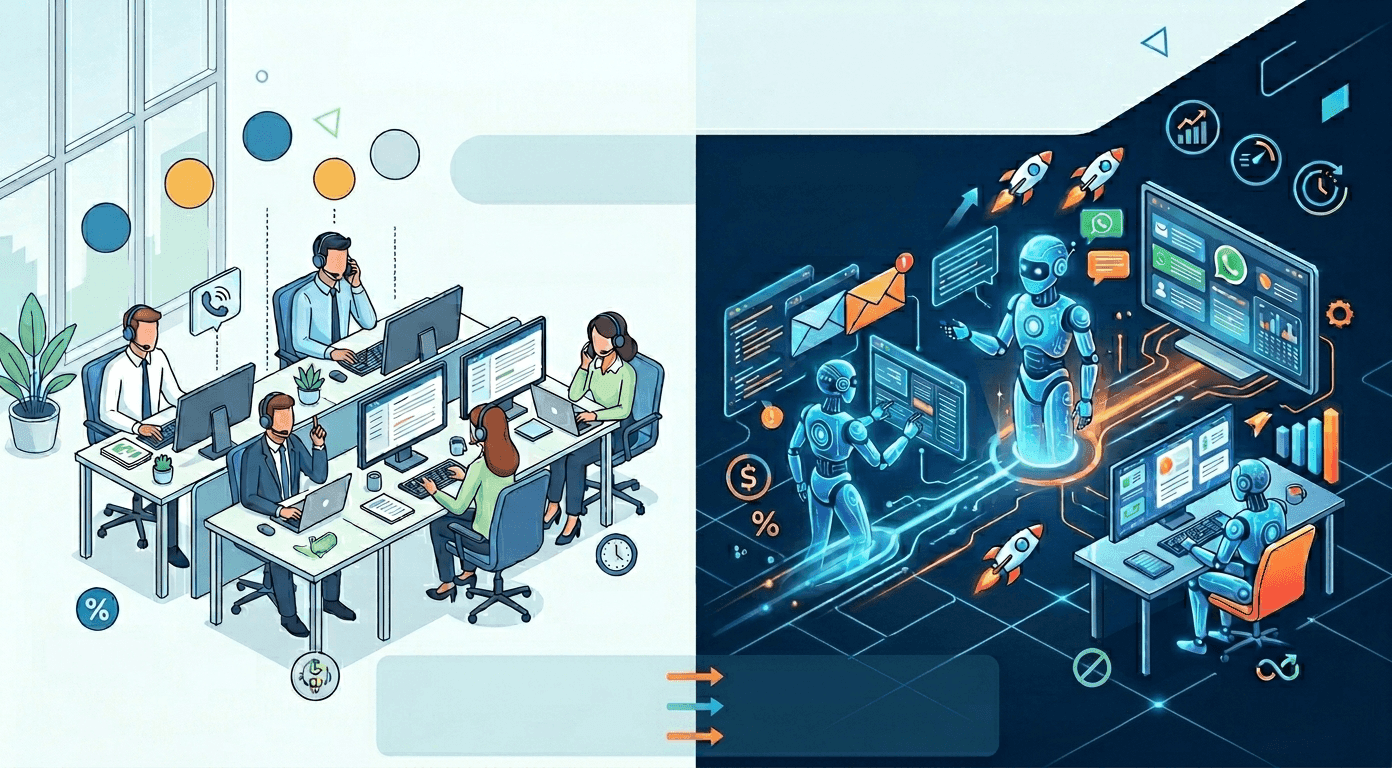
AI Sales Automation vs. Human SDRs: The 2026 Cost & ROI Breakdown
For years, Chief Revenue Officers (CROs) have accepted a painful mathematical reality: generating pipeline is expensive. The traditional model for scaling outbound sales involved hiring an army of Sales Development Representatives (SDRs). If you wanted 2x the meetings, you needed 2x the SDRs.
But in 2026, the unit economics of outbound sales have fundamentally changed. The rise of sophisticated AI sales automation has forced finance and revenue leaders to ask a critical question: What is the true ROI of a human SDR compared to an autonomous AI agent?
When you look purely at the balance sheet, the comparison is jarring. However, the decision isn't just about cutting costs—it is about reallocating resources to maximize revenue. In this breakdown, we will examine the fully loaded cost of human SDRs, the transparent economics of AI agents, and how the highest-performing sales teams are blending the two for maximum ROI.
The True Cost of a Human SDR in 2026 (The Hidden Expenses)
When companies budget for a human SDR, they often look only at the On-Target Earnings (OTE). But the "fully loaded cost" of an employee is significantly higher.
1. Base Salary, Commissions, and Benefits
Whether you are hiring in Silicon Valley or building an inside sales team in Bangalore, the base cost of human capital is the largest line item. This includes the base salary, commission payouts for meetings booked, payroll taxes, health insurance, and office overhead.
2. The "SDR Tech Stack" Tax
Human reps cannot dial phones or send emails efficiently without software. For every SDR you hire, you must purchase individual "seat licenses" for a massive tech stack. This typically includes:
A CRM seat (e.g., Salesforce, HubSpot)
A Sales Engagement Platform seat (e.g., Outreach, Salesloft)
A Data Provider seat (e.g., ZoomInfo, Apollo)
A dialer software seat
This "tech stack tax" often adds thousands of dollars per rep, per year, regardless of their actual performance.
3. The Hidden Cost of Turnover & Ramp Time
The average tenure of an SDR is historically short—often ranging from 12 to 16 months. The job is grueling, and burnout is inevitable.
Every time an SDR quits, the company absorbs a massive financial hit. It takes 1-2 months to recruit a replacement, and another 2-3 months of "ramp time" before the new rep is fully productive. During this 4-month gap, pipeline generation halts, but the base salary and tech stack costs continue.
The Cost Structure of AI Sales Automation
In contrast to the heavy, fixed costs of human capital, AI sales automation introduces a lean, variable cost structure to the outbound funnel.
Usage-Based Pricing (Pay for What You Use)
Modern AI SDRs, like those built on tri-channel platforms, do not require base salaries, health insurance, or per-user seat licenses. Instead, they operate on a consumption model. You pay a baseline platform fee, and then you pay purely for what the AI consumes:
A fraction of a cent per email sent.
Standard Meta API rates per WhatsApp conversation.
A few cents per minute of actual AI voice talk-time.
If you have a slow month, your costs go down. If you need to scale up for a massive product launch, your costs scale predictably without needing to negotiate new software licenses or hire temps.
Zero Ramp Time & Infinite Scalability
When you "hire" an AI SDR, the ramp time is measured in minutes, not months. You upload your sales playbooks, objection handling documents, and ICP data, and the AI is instantly an expert on your product. It does not quit, it does not get tired, and you can instantly scale its output from 100 calls a day to 10,000 calls a day with the click of a button.
Head-to-Head ROI Comparison: Human SDR vs. AI Agent
How do these cost structures translate to actual Return on Investment (ROI)? Let’s compare them on output.
Volume & Speed to Lead
- Human SDR: A top-performing human rep can make perhaps 80-100 dials and send 50 personalized emails a day. Furthermore, if an inbound lead comes in at 2:00 AM, the human cannot respond until the next morning—by which time the lead is cold.
- AI Sales Agent: An AI can execute 10,000 dials simultaneously while managing 5,000 WhatsApp chats. It provides a 0-second "Speed to Lead" response time, 24 hours a day, 7 days a week. The sheer volume of top-of-funnel activity drastically lowers the Cost Per Lead (CPL).
Quality of Output (Emotional Fatigue vs. AI Consistency)
- Human SDR: Call reluctance is a real financial drain. After hearing "No" 40 times in a row, a human rep's tone of voice drops, their energy fades, and they may stumble on their 41st pitch, losing a potentially great deal.
- AI Sales Agent: AI does not have an ego. It executes the 10,000th call of the day with the exact same perfect intonation, enthusiasm, and adherence to the script as the very first call.
The Hybrid Model: Maximize ROI by Keeping Both
The highest ROI does not come from firing your entire sales team. It comes from the Hybrid Model.
RevOps leaders realize that paying a human being $80,000 a year to dial dead numbers is a terrible use of capital. Instead, they deploy AI sales automation to handle the grueling, high-rejection 85% of the sales funnel—the initial dialing, the WhatsApp follow-ups, and the basic qualification.
This protects the human reps from burnout. The human reps are elevated to Account Executives (AEs) or Closers. They spend 100% of their time talking to warm, pre-qualified prospects that the AI agent has handed off. Your closing rates skyrocket, and your Customer Acquisition Cost (CAC) plummets.
Scaling Outbound Profitably with Rapid Sales
If you want to transition to this high-ROI model, you need a platform that replaces the bloated "SDR Tech Stack" with a single, unified execution engine.
Rapid Sales is the ultimate AI outbound assistant. It combines Email, official WhatsApp Business API integration, and human-like AI Voice Calling into one dashboard. You no longer need to pay for disjointed dialers and sequencing tools.
Rapid Sales acts as your autonomous SDR, working 24/7 on a transparent, usage-based pricing model. It qualifies your leads, filters out the noise, and executes a seamless Smart Handoff so your human team can focus entirely on closing revenue.
Conclusion
When comparing AI sales automation vs. human SDRs, the math speaks for itself. The fully loaded cost of human reps—compounded by software seats, ramp time, and turnover—makes manual top-of-funnel prospecting financially unsustainable in 2026.
By shifting the heavy lifting to AI agents, businesses can dramatically lower their pipeline generation costs while actually increasing the output and morale of their human closers.
Ready to transform your unit economics? Book a Demo Now and calculate the ROI of your first AI sales agent.