The Complete Guide to AI Voice Agents for Sales (2026)
For years, the most expensive bottleneck in any revenue engine has been the phone. Dialing hundreds of numbers, listening to ringtones, leaving voicemails, and navigating immediate rejections drains human capital faster than almost any other business activity.
By 2026, the economics of outbound sales have fundamentally changed. The concept of hiring top-tier sales talent only to use them as human dialers is obsolete. Today, high-performing sales teams are deploying AI voice agents to do the heavy lifting at the top of the funnel.
But what exactly separates a modern AI voice agent from the robotic, frustrating automated menus of the past? How do they handle interruptions, and how can businesses deploy them without alienating their prospect base? This complete guide breaks down everything you need to know about AI voice agents for sales.
What is an AI Voice Agent for Sales?
An AI voice agent for sales is an autonomous, conversational artificial intelligence system capable of executing live, two-way phone calls with prospects. Unlike older automated systems that require users to press numbers on a keypad, modern AI voice agents use Natural Language Processing (NLP) to listen to a prospect, understand the context of their response, generate a highly relevant reply, and speak it back in a cloned, human-sounding voice. They act as automated Sales Development Representatives (SDRs) tasked with cold calling, lead qualification, and appointment setting.
The Evolution: Clunky IVR vs. 2026 Conversational AI
To understand the power of current technology, it is crucial to draw a hard line between legacy systems and modern generative AI voice agents.
Legacy IVR (Interactive Voice Response):
Logic: Rigid, decision-tree based ("Press 1 for Sales, Press 2 for Support").
Voice Quality: Pre-recorded human audio snippets or highly robotic, monotone text-to-speech.
Interactivity: Cannot handle interruptions, tangential questions, or complex objections.
Outcome: High user frustration and immediate hang-ups.
2026 Conversational AI Voice Agents:
Logic: Dynamic, LLM-driven reasoning. The AI adapts the conversation based on the prospect's real-time answers.
Voice Quality: Ultra-realistic text-to-speech with natural pacing, breathing sounds, and varied intonation.
Interactivity: Capable of handling interruptions (barge-in technology), answering FAQs on the fly, and overcoming initial sales objections.
Outcome: Seamless lead qualification that prospects often cannot distinguish from a real human interaction.
Core Use Cases for AI Voice Assistants
The versatility of AI voice agents allows them to solve vastly different operational bottlenecks across various industries.
1. High-Volume B2B Cold Calling & Lead Qualification
A B2B software company or an agency in a bustling commercial hub like Ahmedabad might acquire thousands of leads from a recent webinar or LinkedIn campaign. Manually calling these leads takes weeks, by which time the intent has cooled. AI voice agents can dial 10,000 prospects simultaneously in a single afternoon. The agent introduces the product, gauges interest, and filters out the 90% of junk leads, passing only the 10% of warm prospects to human Account Executives.
2. E-commerce COD Verification & RTO Reduction
In the Indian D2C ecosystem, Cash-on-Delivery (COD) orders drive sales volume but also trigger massive Return to Origin (RTO) costs when buyers reject the package at the door. AI voice agents automatically trigger a call the exact second a COD order is placed. The AI verifies the customer's address and purchase intent in their local regional language. If the customer cancels verbally, the order is flagged before shipping, saving the brand thousands in reverse logistics.
3. Cross-Border Export Sales
For export businesses selling globally, time zones are a persistent hurdle. An AI voice agent doesn't sleep. It can execute hundreds of cold calls to prospective buyers in the US, UK, or Australia during their local business hours, utilizing native Western accents to build immediate rapport, and seamlessly scheduling meetings on the Indian team's calendar for the following day.
Under the Hood: How Do AI Voice Agents Actually Work?
The magic of a seamless AI phone call relies on three distinct technological steps happening in milliseconds.
Ultra-Low Latency Processing (STT $\rightarrow$ LLM $\rightarrow$ TTS)
For a conversation to feel natural, the AI must respond in under 800 milliseconds.
Speech-to-Text (STT): As the prospect speaks, the AI transcribes the audio into text instantly, even accounting for heavy accents or background noise.
Large Language Model (LLM): The AI processes the transcribed text, consults its custom system prompt (the sales script, FAQs, and brand guardrails), and generates a text-based response.
Text-to-Speech (TTS): The text is instantly rendered into highly realistic audio and streamed back through the phone line.
Smart Intent Recognition & Objection Handling
Modern voice models do not get confused by "maybe later" or "send me an email." Because they are powered by advanced NLP, they understand semantic intent. If a prospect says, "I'm busy right now, call me next week," the AI correctly tags the call outcome as a 'Callback' and updates the CRM without missing a beat.
The Smart Handoff (Live Transfers)
The ultimate goal of an AI SDR is to tee up the human closer. When a prospect expresses explicit interest (e.g., "Yes, I am looking to upgrade my software right now"), the AI agent can execute a live warm transfer. It politely asks the prospect to hold for a brief moment, dials the human sales rep, whispers the context of the call to the rep, and bridges the connection.
Best Practices for Deploying AI Voice Bots
Deploying an AI voice agent requires strategy. A poorly implemented bot will burn through your lead list.
Nail the Introduction: Do not try to trick the user for too long. A simple, polite opening that quickly gets to the value proposition is crucial. Transparency about being an AI assistant is often appreciated by modern buyers and sets clear expectations.
Keep Scripts Concise: Humans speak in short, punchy sentences on the phone. Do not program your AI to deliver a three-paragraph monologue. It should ask questions and listen.
Omnichannel Coordination: Voice should never exist in a vacuum. The best outbound campaigns tie AI voice calls to Email and WhatsApp sequences. If an AI call goes to voicemail, the system should automatically trigger a personalized WhatsApp message.
Monitor Compliance: Ensure your AI dialing adheres to local telemarketing regulations (such as DND registries in India or TCPA rules in the United States). Use official telecom APIs to ensure your business numbers are not flagged as spam.
Why Rapid Sales is the Ultimate Voice AI Solution
Scaling an outbound voice campaign usually requires stitching together multiple tools—a telecom provider, an AI engine, a CRM, and an email sender. Rapid Sales eliminates this friction.
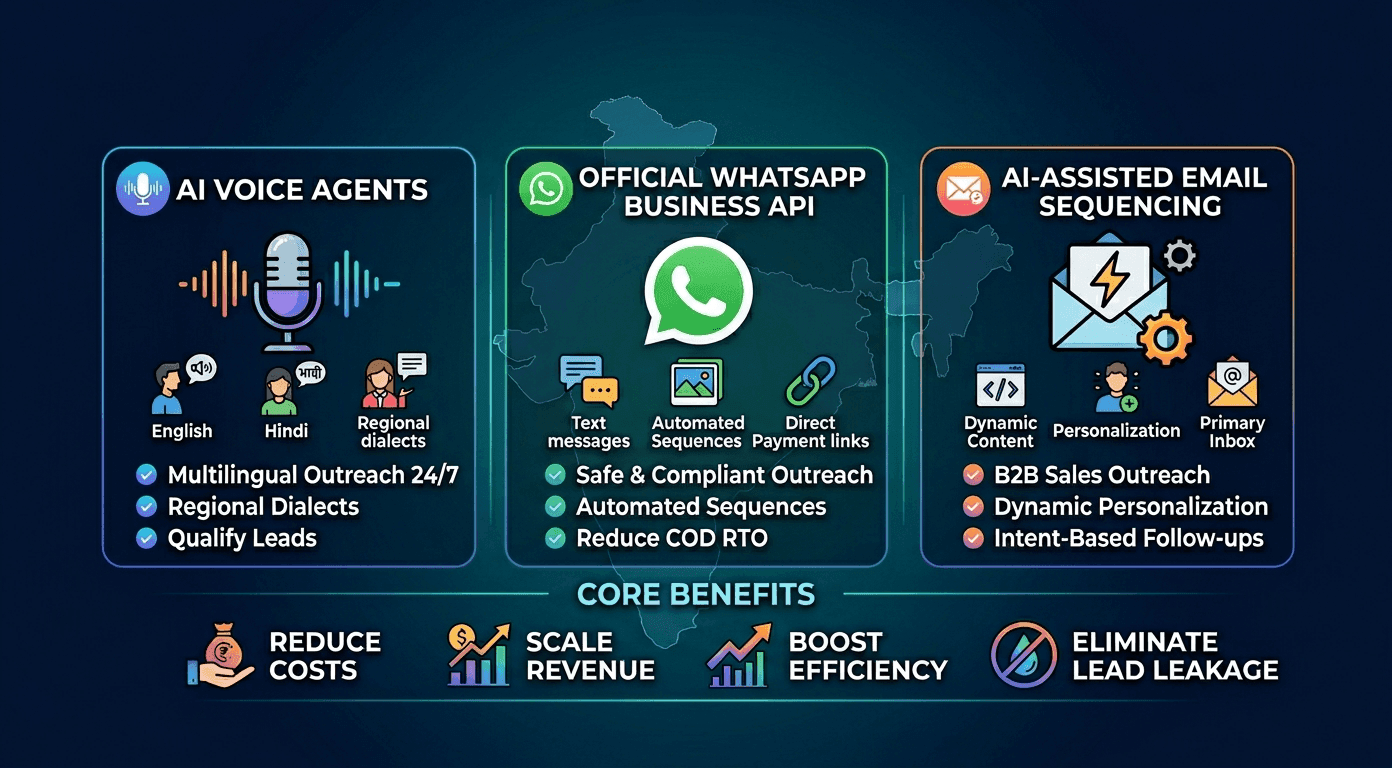
As a unified outbound automation platform, Rapid Sales gives you access to state-of-the-art AI voice calling natively integrated with WhatsApp and Email sequences.
- Native Multi-Lingual Capabilities: Engage buyers in English, Hindi, and various regional dialects flawlessly.
- Stop-on-Reply Logic: If a prospect replies to your WhatsApp text, the Rapid Sales system instantly cancels the scheduled AI voice call to prevent annoying the buyer.
- Unified Lead Timeline: Before your human team takes over a hot lead, they can view the full transcript of the AI's conversation in a centralized dashboard, ensuring total context.
You upload the leads; the Rapid Sales Smart Assistant qualifies them.
Conclusion
The era of manual cold calling is drawing to a close. AI voice agents for sales are no longer a futuristic concept—they are a mandatory requirement for any B2B or D2C business that wants to scale its outbound volume efficiently. By automating the qualification process, filtering out junk leads, and executing flawless multi-channel follow-ups, AI allows your sales team to stop acting like dialers and start acting like closers.
Stop losing leads to missed follow-ups and manual fatigue. Book a Demo Now to deploy your first AI voice agent in minutes.