Follow-Up Automation for High-Ticket Sales: Navigating Complex Buyer Journeys
How do you automate follow-ups for high-ticket sales?
High-ticket sales follow-up requires a strategic, multi-touch cadence across several months. To automate this effectively without appearing robotic, B2B businesses must use a unified CRM platform to trigger formal email sequences for value delivery, WhatsApp messages for immediate text-based nudges, and AI voice calls for instant qualification. Crucially, the automation must feature "stop-on-reply" logic to instantly pause sequences the moment a buyer engages, allowing a human sales representative to seamlessly take over the complex negotiation.
Selling a $50 T-shirt requires a great Facebook ad and a smooth checkout page. Selling a $50,000 custom software package, a commercial real estate property, or an enterprise consulting retainer requires an entirely different methodology.
High-ticket sales are never impulse purchases. They involve multiple decision-makers, extensive budget approvals, and a complex buyer journey that can stretch from three to twelve months. Because the sales cycle is so long, the single biggest factor determining whether a deal closes or dies is the quality and consistency of your sales follow-up.
Unfortunately, human sales representatives are poorly equipped to manage long-term nurturing manually. They focus on the hottest leads of the week and let leads from three months ago slip through the cracks. To scale high-ticket revenue, modern B2B teams are deploying advanced follow-up automation.
The Anatomy of a High-Ticket Buyer Journey
In a complex B2B sale, the buyer goes through several distinct psychological phases:
- Problem Awareness: They realize their current operations are failing.
- Solution Investigation: They research vendors, book demos, and gather pricing.
- Internal Consensus: They present options to their board or C-suite.
- Negotiation and Closing: They review contracts and security compliance.
If your sales team treats a buyer in the "Internal Consensus" stage the exact same way they treat a buyer in the "Problem Awareness" stage, you will lose the deal. High-ticket follow-up automation allows you to map specific communication triggers to specific pipeline stages.
Where Manual Follow-Up Fails in Complex B2B Sales
Before examining the automation blueprint, it is critical to understand why traditional, manual sales cadences fail in high-ticket environments.
The "Just Checking In" Fatigue
When a sales rep has 50 leads in their pipeline, they do not have time to write deeply personalized emails for everyone. They resort to sending generic emails that say, "Hi John, just checking in to see if you have an update on the proposal." This offers zero value to the buyer and makes the seller look desperate. Over a 6-month cycle, this causes the prospect to simply stop replying.
Fragmented Communication Silos
High-ticket deals happen across multiple platforms. A prospect might reply to an email, ask a quick question on WhatsApp, and then jump on a phone call. If your sales reps are managing WhatsApp on their personal phones and emails in their personal Gmail accounts, the context of the deal is shattered. When a rep forgets what was promised on a WhatsApp chat three weeks ago, buyer trust evaporates.
Multi-Channel Sequencing: The Automation Blueprint
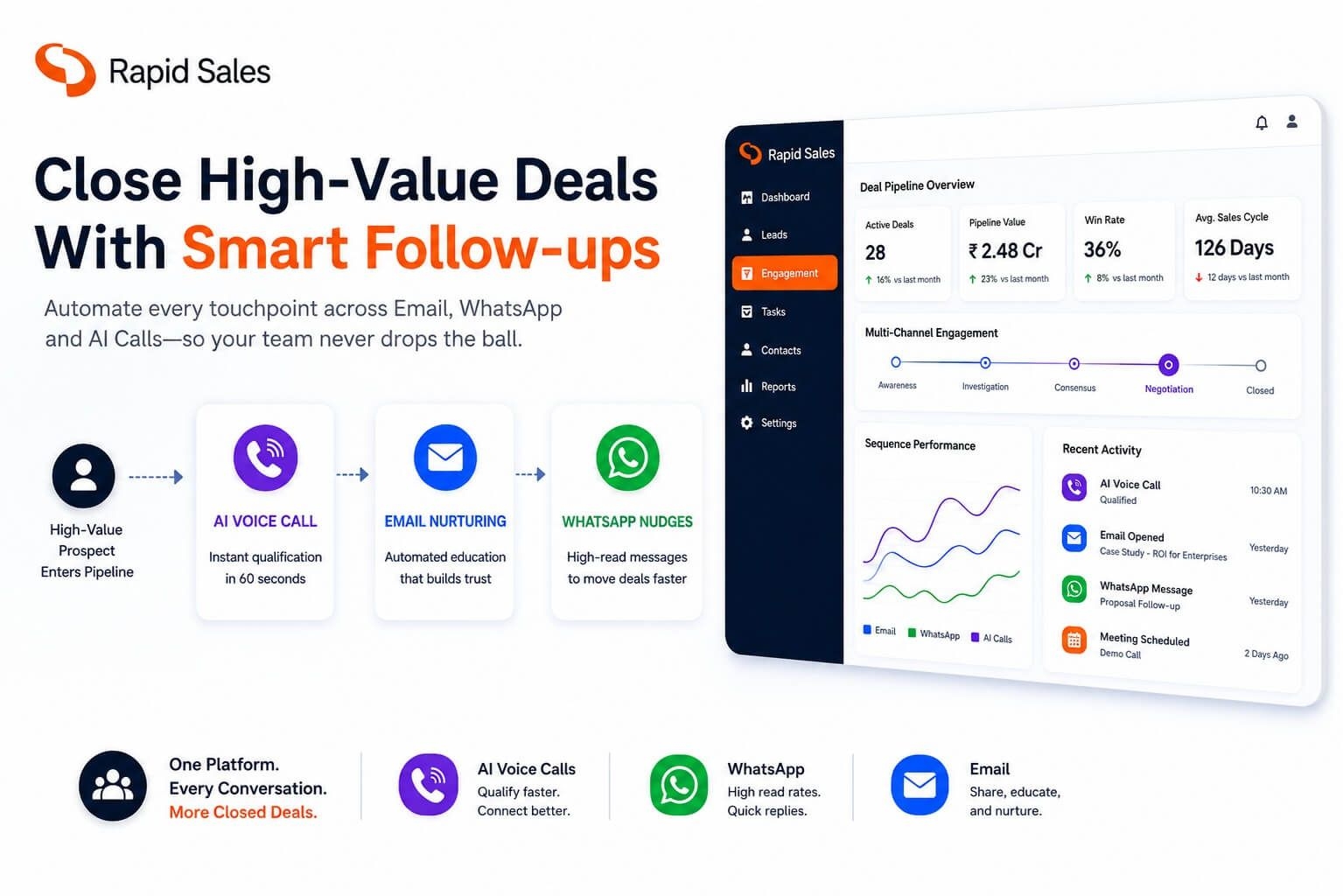
To automate high-ticket sales successfully, you must stop relying entirely on email. You need a multi-channel sequence that leverages the unique strengths of Email, WhatsApp, and AI Voice.
Top of Funnel: Speed and AI Qualification
When a high-ticket lead enters your pipeline (e.g., they download a whitepaper or request a consultation), speed is paramount.
- The Automation: Trigger an immediate AI voice call. The conversational AI can qualify the lead's budget and timeline within 60 seconds, ensuring your human sales reps don't waste hours on unqualified tire-kickers.
Middle of Funnel: Email Education & Nurturing
Once the lead is qualified, they enter the research phase. This is where email shines. Email is your formal system of record.
- The Automation: Set up a 6-week automated email drip campaign. Instead of "checking in," these emails should automatically deliver case studies, ROI calculators, and industry reports. This positions your brand as an authoritative consultant while keeping your company top-of-mind.
Bottom of Funnel: WhatsApp Velocity
When a proposal has been sent and you are waiting for a signature, email is too slow.
- The Automation: Trigger an automated WhatsApp message three days after the proposal is sent: "Hi [Name], I sent over the final contract to your email on Tuesday. Let me know if your procurement team needs any additional details. Happy to jump on a quick call!" WhatsApp boasts a 90%+ read rate, guaranteeing your message cuts through their crowded inbox.
The Secret to B2B Automation: Cross-Channel Stop-on-Reply
The biggest fear sales directors have about automation is that it will make their team sound like robots, offending a high-value prospect.
This happens when software tools are disjointed. If you use a standalone email tool and a separate WhatsApp tool, a prospect might text you saying, "We are ready to sign," but your email tool will still send an automated message the next day saying, "Are you still interested?"
To prevent this, you must use a unified CRM equipped with a cross-channel Stop-on-Reply engine. When all communication flows through one platform, the system is intelligent enough to instantly pause all upcoming automated emails and AI calls the exact second the prospect replies to a WhatsApp message.
Takeaway: Stop-on-Reply logic ensures that automation does the heavy lifting of chasing the lead, but the human seamlessly takes over the moment the prospect raises their hand.
The Importance of a Unified Customer Timeline
When closing a $100,000 deal, context is your most valuable asset. A unified sales communication platform logs every single touchpoint on a chronological timeline.
When your closer steps into a negotiation meeting, they can look at one dashboard and see the AI call summary from day one, the four automated emails the prospect opened, and the WhatsApp chat history. This total visibility ensures a frictionless buyer experience and drastically shortens the sales cycle.
Master Complex Sales with Rapid Sales
High-ticket sales require patience, persistence, and flawless execution. You cannot afford to let premium leads decay because a sales rep forgot to set a calendar reminder.
Rapid Sales is the ultimate sales communication platform built to handle complex B2B buyer journeys. We give your team the power to build sophisticated, multi-channel automated sequences that seamlessly blend formal email nurturing, high-velocity WhatsApp messaging, and intelligent AI voice qualification. With our native stop-on-reply engine and unified customer timeline, your reps maintain absolute control and context over every deal.
Stop losing high-value deals to follow-up fatigue. Explore Rapid Sales for your sales team and automate your high-ticket pipeline today.