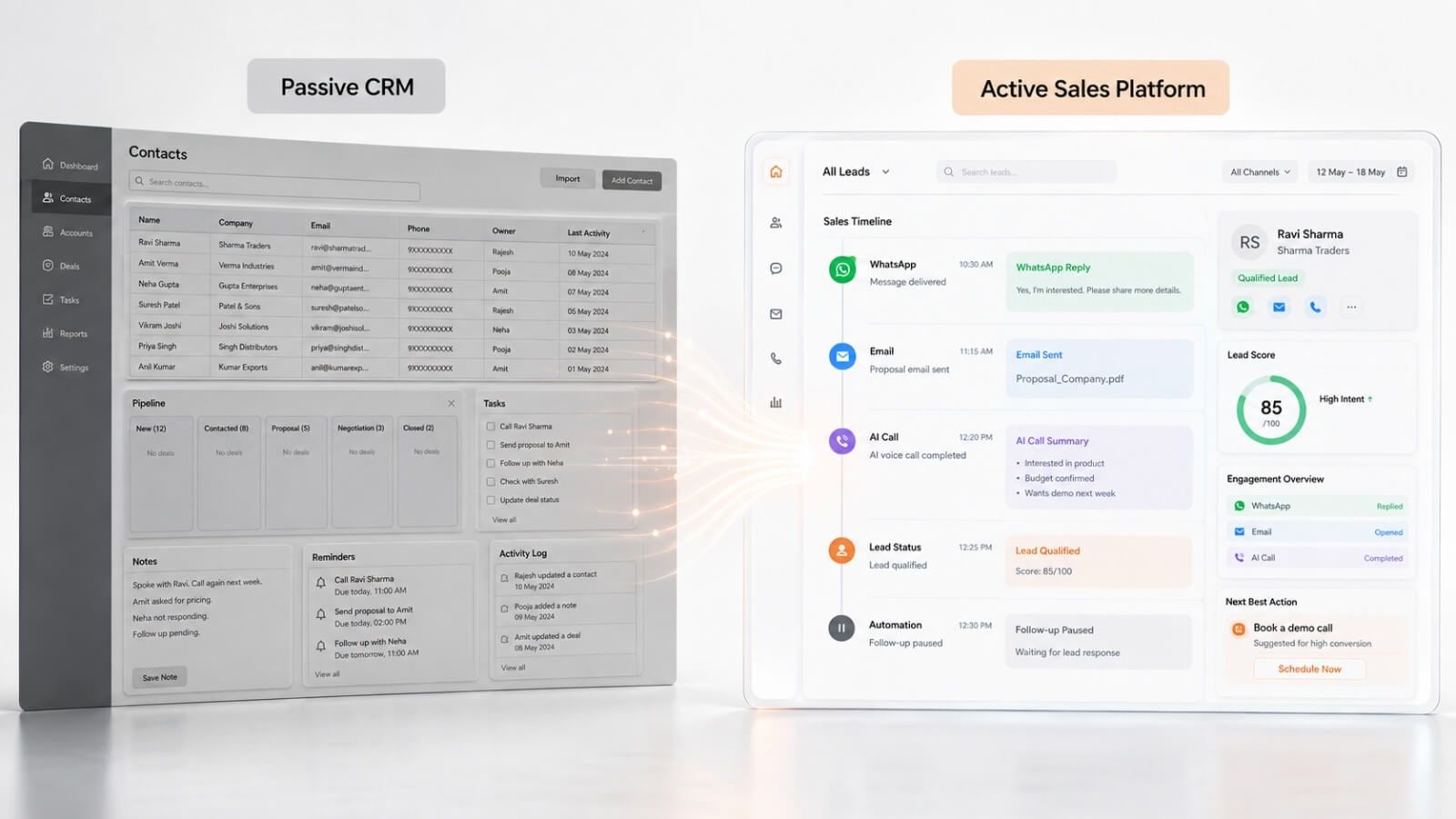
Traditional CRM vs. Automated Sales Communication Platforms
What is the difference between a traditional CRM and a sales communication platform?
A traditional Customer Relationship Management (CRM) system is a passive database; it requires human sales representatives to manually type in notes, log call durations, and update deal stages. An automated sales communication platform is an active engine. It directly executes your outreach—triggering WhatsApp messages, sending emails, and making AI voice calls—and then automatically logs those interactions onto a unified timeline, completely eliminating manual data entry.
Talk to any B2B sales director, and they will likely share the same recurring frustration: getting their sales representatives to update the CRM.
For the last twenty years, businesses have invested heavily in traditional CRM software. They buy expensive licenses, undergo weeks of onboarding, and set strict rules that "if it isn't in the CRM, it didn't happen." Yet, pipelines remain inaccurate, WhatsApp chats go unlogged, and follow-ups fall through the cracks.
Why? Because traditional CRMs are fundamentally misaligned with how modern sales teams actually work. To scale your outbound operations in 2026, you must understand the difference between a passive legacy database and an active automated sales communication platform.
The Fundamental Flaw of Traditional CRMs
The problem with legacy CRM software is not a lack of features; it is a flaw in the core architecture. Traditional CRMs were built for management reporting, not for sales execution.
The "Digital Filing Cabinet"
A traditional CRM operates like an expensive digital filing cabinet. It holds contact information, company details, and expected deal values perfectly. But it is entirely passive. It sits there, waiting for a human being to feed it information. It does not send WhatsApp messages, it does not dial phone numbers, and it does not listen to customer objections.
The Data Entry Problem (Why Reps Hate CRMs)
Because the traditional CRM is passive, the burden of data entry falls entirely on your highest-paid employees: your sales closers. After a 15-minute discovery call, a rep must open the CRM, find the contact, type out a summary of the call, manually schedule a follow-up task, and update the deal stage. This administrative burden causes massive friction. Reps cut corners, leave out vital details, or forget to update the system entirely, leading to "dead" pipelines and blind sales managers.
What is an Automated Sales Communication Platform?
An automated sales communication platform flips the architecture upside down. Instead of being a place where you record work, it is the place where you do the work.
Platforms like Rapid Sales combine the database functionality of a CRM with the execution power of an automation engine. The platform itself holds the WhatsApp API, the email sequencer, and the AI voice calling infrastructure natively.
Core Differences: Passive CRM vs. Active Communication
When evaluating your sales tech stack, here are the three core differences that dictate why modern teams are abandoning legacy CRMs.
1. Action vs. Storage
- Traditional CRM: A lead submits a Meta ad form. The CRM creates a contact record and assigns a "Task" to a sales rep: Call Lead Today. The lead sits there until the human acts.
- Automated Platform: A lead submits a form. The platform instantly triggers an AI voice call to qualify the buyer and simultaneously sends a WhatsApp booking link. The platform executes the outreach in under 60 seconds without human intervention.
2. Fragmented Tools vs. Native Integration
- Traditional CRM: Because the CRM can't execute outreach, businesses must buy third-party add-ons. They buy a separate email tool and a standalone cloud dialer, duct-taping them to the CRM using fragile webhooks (like Zapier).
- Automated Platform: Text, formal B2B email, and voice channels are built into the core code. If a prospect replies to an email, the system's cross-channel "stop-on-reply" engine automatically pauses upcoming WhatsApp nudges natively.
3. Manual Notes vs. AI Transcripts
- Traditional CRM: Managers must beg reps to type detailed notes after a sales call so they know why a deal was lost.
- Automated Platform: When a call concludes, the platform's conversational intelligence automatically generates a line-by-line transcript and a short, bulleted AI summary, pasting it instantly onto the client's timeline. Manual data entry is completely eliminated.
The Financial Cost of Clunky CRM Systems
Many founders hold onto their legacy CRM because they fear the pain of migration. What they fail to realize is the hidden financial cost of their current setup.
First, you are paying for software tool sprawl. You are paying one invoice for your CRM, another for your dialer, and a third for your WhatsApp marketing tool.
Second, you are suffering from a high Opportunity Cost. Every hour your sales team spends doing manual data entry is an hour they are not pitching prospects. If an automated communication platform can give your team back 10 hours a week by automating their follow-ups and call logging, the software pays for itself in a matter of days.
Why the Modern Buyer Requires an "Active" System
The modern B2B buyer demands speed and omnichannel flexibility. They might ask a quick question on WhatsApp, expect a formal proposal via email, and want a quick phone call to finalize pricing.
A traditional CRM forces your reps to jump between their personal WhatsApp app, their Gmail inbox, and a desk phone, losing the context of the deal at every jump. An automated sales communication platform keeps the entire customer journey organized chronologically on a single dashboard, allowing your reps to respond with devastating speed and perfect context.
Upgrade to a Unified Sales Engine with Rapid Sales
Stop forcing your sales team to act as data-entry clerks for a passive database.
Rapid Sales is the ultimate automated sales communication platform, designed to replace your clunky legacy CRM and your fragmented third-party outreach tools. We give your team a unified workspace where they can launch multi-channel sequences, manage high-velocity WhatsApp chats, and audit AI call summaries—all from a single, intuitive dashboard.
By moving from a passive storage system to an active execution engine, you eliminate follow-up gaps, ensure 100% accurate pipeline data, and empower your team to close more deals.
See the difference an active platform makes. Book a Rapid Sales demo today and upgrade your sales tech stack.