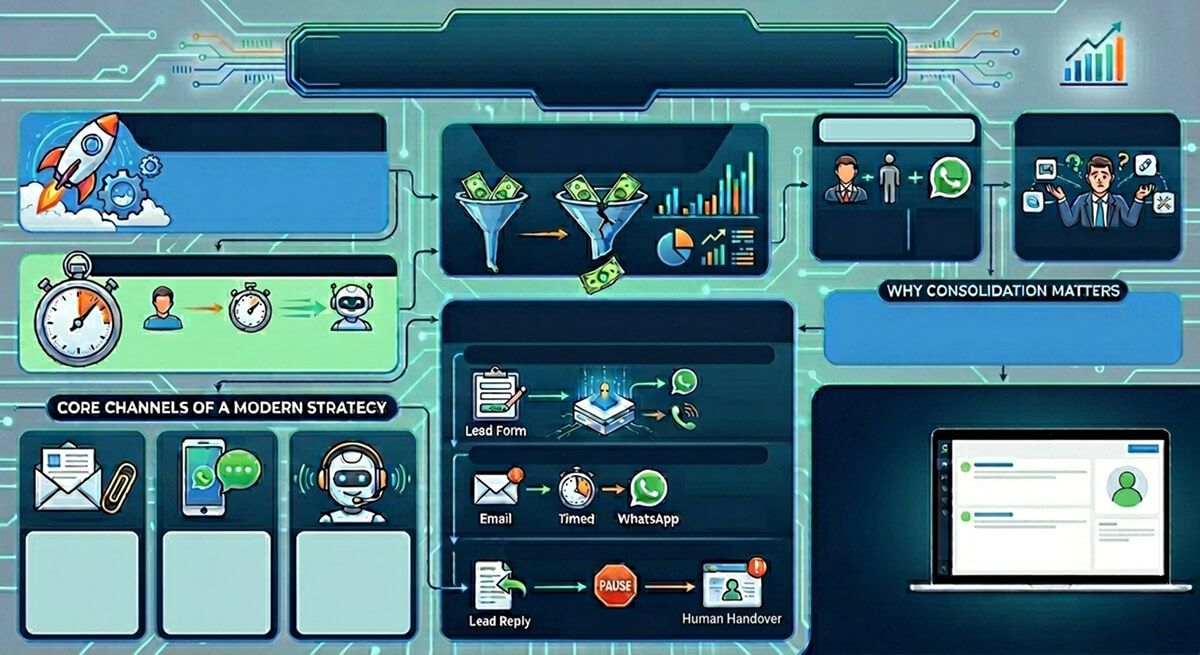
The High Cost of Slow Lead Response Times in B2B Sales
What is the impact of lead response time on conversion rates?
Lead response time—or "speed-to-lead"—is the critical metric measuring how quickly a business engages a prospect after they submit an inquiry. Data confirms that the odds of qualifying a lead are 21 times greater if contacted within 5 minutes versus 30 minutes. Waiting even a few hours results in severe "lead decay," dropping conversion probability by up to 80%. To protect ROI, modern teams use automation to execute instant multi-channel outreach in under 60 seconds.
In the high-stakes world of B2B sales, speed is not just an advantage; it is the entire game.
Imagine a director at a growing company realizes they have an operational bottleneck. They search the web, find your landing page, and fill out an inbound request form. Their interest, intent, and urgency are at an absolute maximum.
They close their laptop, step away for coffee, and wait.
Four hours later, one of your sales development representatives (SDRs) spots the notification, clicks dial, and leaves a voicemail. By that time, the prospect has forgotten they filled out your form, moved on to a competitor, or solved the issue internally.
In modern sales operations, speed-to-lead is a foundational revenue metric. If you fail to understand the cost of a slow response time, your pipeline is silently leaking money.
What is Speed-to-Lead? (The Math Behind the Loss)
Lead response velocity measures the time elapsed from the moment a prospect raises their hand (submitting a form, downloading an asset, clicking a contact button) to the exact second a human or system makes contact.
Decades of sales research reveal a sobering reality for B2B organizations:
- The 5-Minute Cliff: The odds of qualifying a lead drop by 80% if you wait just 5 minutes to make contact, compared to calling them in the first minute.
- The Flatline: After 30 minutes, your chances of connecting with and qualifying that buyer plummet dramatically.
When your sales team operates on an ad-hoc, manual schedule, they inherently miss the window of peak buyer intent.
The Anatomy of Lead Decay
Lead decay is the natural degradation of a prospect’s interest and responsiveness over time. It happens in two highly specific scenarios that destroy outbound ROI.
The 5-Minute Cliff
Buyer psychology is driven by momentum. When a decision-maker decides to make a purchase or evaluate a vendor, they are emotionally invested in that instant. If you respond instantly, you validate their decision and capture their attention while their guard is down. If you delay, logic and distractions creep back in, and they transform from a warm, enthusiastic lead into a cold, reluctant prospect.
The Overnight Black Hole
For businesses dealing with international clients—such as exporters in Ahmedabad catering to the US or European markets—lead decay is compounded by time zones. Inquiries arrive overnight while your team sleeps. If nobody follows up until your office opens at 10 AM IST, your international prospects have already started their workday and engaged local competitors.
Why Slow Follow-Ups Happen (The Manual Bottleneck)
Why do sales teams take hours, or even days, to respond to inbound requests? It is rarely due to laziness. It is the result of operational bottlenecks.
In a traditional setup, when a form is submitted, an email notification trickles into a shared inbox. A human must see it, assign it to an SDR, open a CRM, look up the phone number, and manually type an email or dial a desk phone.
Humans cannot scale at the speed of software. When sales qualification relies purely on manual administrative effort, response times inevitably drag.
The Financial Damage of Neglected Leads
The direct financial damage of a slow response time is clear: a depressed win rate.
Think about your customer acquisition cost (CAC). You spend thousands of dollars on ad spend, SEO, and content marketing to drive high-intent buyers to your website. You successfully convince them to fill out a demo request.
By failing to follow up instantly, you effectively set that ad spend on fire. You pay for the traffic, generate the lead, and then hand the sale to a competitor simply because your administrative lead response time is too slow.
Fixing Pipeline Leakage with Instant Automation
To protect your pipeline and maximize ROI, you must remove human manual labor from the initial touchpoint.
The most successful scaling companies employ an "Always-On" automated communication engine. The millisecond a lead form is submitted, the platform instantly triggers outreach:
- It immediately dispatches an SMS or WhatsApp text containing a calendar link.
- It simultaneously sends a formal email with relevant case studies.
- If necessary, it instantly dials the prospect via an AI voice agent to qualify their budget and book a meeting on the spot.
Automating your response time guarantees that you never miss the 5-minute qualification window, regardless of whether it is midday or midnight.
Accelerate Your Sales Velocity with Rapid Sales
Stop letting administrative bottlenecks and slow follow-ups drain your marketing budget.
Rapid Sales is the unified sales communication platform built to maximize your speed-to-lead. By leveraging native WhatsApp automation, automated email sequences, and conversational AI voice agents, Rapid Sales engages your inbound leads in under 60 seconds, completely bypassing manual SDR delays.
Our system ensures that your sales team only speaks to pre-qualified, highly interested buyers whose appointments are already booked securely on your calendar.
Never lose a high-intent lead to a slow response again. Book a Rapid Sales demo today to accelerate your sales velocity and protect your bottom line.