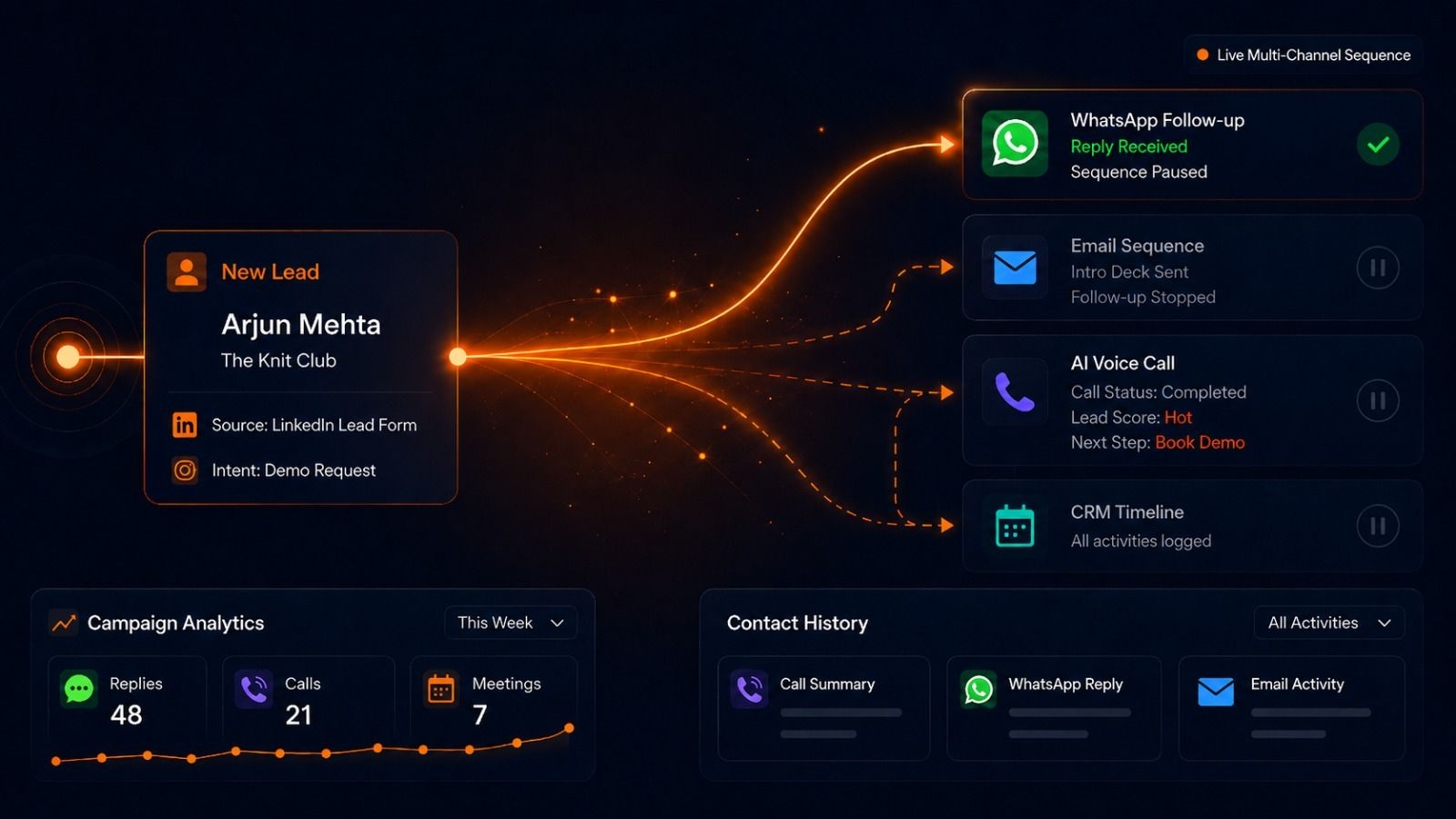
Combining WhatsApp, Email, and Voice for the Ultimate Sales Sequence
What is a multi-channel sales sequence?
A multi-channel sales sequence is a coordinated, automated outreach strategy that engages prospective buyers across several communication platforms—most notably email, WhatsApp, and voice calls. By weaving these touchpoints into a single, cohesive timeline, businesses maximize their lead response rates, eliminate follow-up gaps, and accelerate the B2B sales cycle.
If your sales team is relying exclusively on email sequences, your outreach is being buried under thousands of other promotional messages. If you rely exclusively on WhatsApp, you risk appearing too informal for complex B2B contract negotiations. If you rely exclusively on manual cold calling, your sales representatives will inevitably burn out chasing voicemails.
In 2026, the most effective sales organizations do not force buyers into a single communication lane. Instead, they build automated, multi-channel sales sequences that combine the unique strengths of text, mail, and voice.
This guide breaks down why single-channel outreach fails and provides a step-by-step blueprint for building an omnichannel sequence that converts.
Why Single-Channel Sales Sequences Fail
The core flaw of a single-channel strategy is that it assumes every prospect prefers the same communication style.
Some executives live in their email inbox and ignore unsolicited phone calls. Other busy founders will ignore a 500-word email but will instantly reply to a 10-word WhatsApp text. When your sales software only supports one channel, you alienate a massive percentage of your target audience simply because of medium preference.
Furthermore, single-channel platforms create tool sprawl. When a team uses one software for email sequences and another for WhatsApp blasts, the data is siloed. A prospect might reply to your WhatsApp message, but because your email tool doesn't know that, it sends an automated "Just following up!" email three hours later. This disjointed experience destroys buyer trust.
The Anatomy of the Ultimate Multi-Channel Stack
To build a flawless sequence, you must understand the specific psychological role each channel plays in the modern sales process.
Email: The System of Record
Professional email is not dead; its purpose has just evolved. Email should no longer be relied upon for immediate, high-velocity answers. Instead, it acts as your system of record. It is the formal channel used to deliver detailed product brochures, secure pricing proposals, calendar invites, and legal contracts. It provides the structured foundation of your sequence.
WhatsApp: The Velocity Engine
WhatsApp business automation provides speed. It boasts read rates that obliterate traditional email marketing. In a multi-channel sequence, WhatsApp is your velocity engine. It is used for quick pattern interrupts, immediate lead acknowledgments, rapid qualification questions, and fast demo booking.
AI Voice: The Trust and Qualification Layer
Text channels are highly scalable, but human voices build trust and urgency. Incorporating AI voice calling into your sequence allows you to instantly qualify a lead's intent without requiring a human sales rep to sit by the phone. AI agents can ask about budgets and timelines, seamlessly logging those answers as searchable transcripts directly into your CRM.
The Ultimate Multi-Channel Sales Sequence (A Step-by-Step Blueprint)
How do you combine these three elements into an automated, non-intrusive flow? Here is a high-converting blueprint designed for inbound B2B lead generation.
Day 1: The Immediate Omnichannel Strike
Goal: Respond before the prospect cools off or contacts a competitor.
- Minute 0 (Form Submission): The moment the lead enters your system, Rapid Sales triggers an immediate AI voice call. The AI agent introduces itself, confirms the prospect's interest, and asks 2-3 brief qualification questions (e.g., “Are you looking to implement this within the next 30 days?”).
- Minute 2: Immediately after the call concludes (or if the call goes to voicemail), an automated WhatsApp message is triggered: “Hi [Name], thanks for registering! I just tried reaching out. Are you available for a quick 10-minute demo tomorrow?”
- Minute 15: A formal introductory email is dispatched containing a link to your company overview deck and a calendar booking link.
Day 2 & 3: The Multi-Channel Nurture
Goal: Provide value and gently prompt a response without being overly aggressive.
- Day 2 (Email): Send a high-value case study related to the prospect's industry. Subject: How [Similar Company] solved [Specific Pain Point].
- Day 3 (WhatsApp): A brief, conversational text nudge. “Hi [Name], just checking if you had a chance to glance at the case study I emailed over yesterday? Happy to answer any questions.”
Day 4 & 5: The Voice Follow-Up and Breakup
Goal: Force a "yes" or "no" decision to clean up your sales pipeline.
- Day 4 (AI Voice Call): A second automated AI call is dispatched to check in. If answered, the AI offers to transfer the prospect directly to a live human account executive.
- Day 5 (Email & WhatsApp Breakup): If there has been zero engagement, the sequence ends with a professional breakup message sent via email and WhatsApp: “Hi [Name], I haven't heard back, so I'll assume this isn't a priority right now. I'll stop reaching out, but feel free to reply here whenever you are ready to reconnect.”
The Golden Rule: Cross-Channel "Stop-on-Reply"
This sequence is highly aggressive and effective—but it relies entirely on one critical piece of technology: a unified Stop-on-Reply engine.
If you attempt to build this sequence using three different software tools connected via fragile webhooks, disaster will strike. If a prospect replies "Yes, let's chat tomorrow" to your Day 1 WhatsApp message, your standalone email software won't know to stop. It will still send the Day 2 and Day 3 follow-ups, making your brand look foolish and robotic.
A true multi-channel sales sequence must be hosted on a centralized platform that monitors all channels simultaneously. The second a lead responds to an email, answers an AI call, or replies on WhatsApp, the system must instantly pause all future automated touchpoints across the entire ecosystem.
Unify Your Outreach with Rapid Sales
Building a sophisticated, cross-channel sales workflow does not require a team of developers or a massive software budget.
Rapid Sales is built from the ground up to be the ultimate omnichannel sales communication platform. By consolidating WhatsApp automation, email sequences, and AI calling into one intuitive dashboard, Rapid Sales eliminates data silos and tool sprawl.
Your sales representatives can monitor live ad campaigns, track campaign analytics, and view AI call summaries and text chat logs on a single, chronological timeline. With our built-in cross-channel stop-on-reply engine, you can automate your outreach confidently, knowing your prospects will experience a flawless, professional journey.
Stop losing deals to fragmented follow-ups. Book a Rapid Sales demo today and see how easy it is to launch your first multi-channel sales sequence.