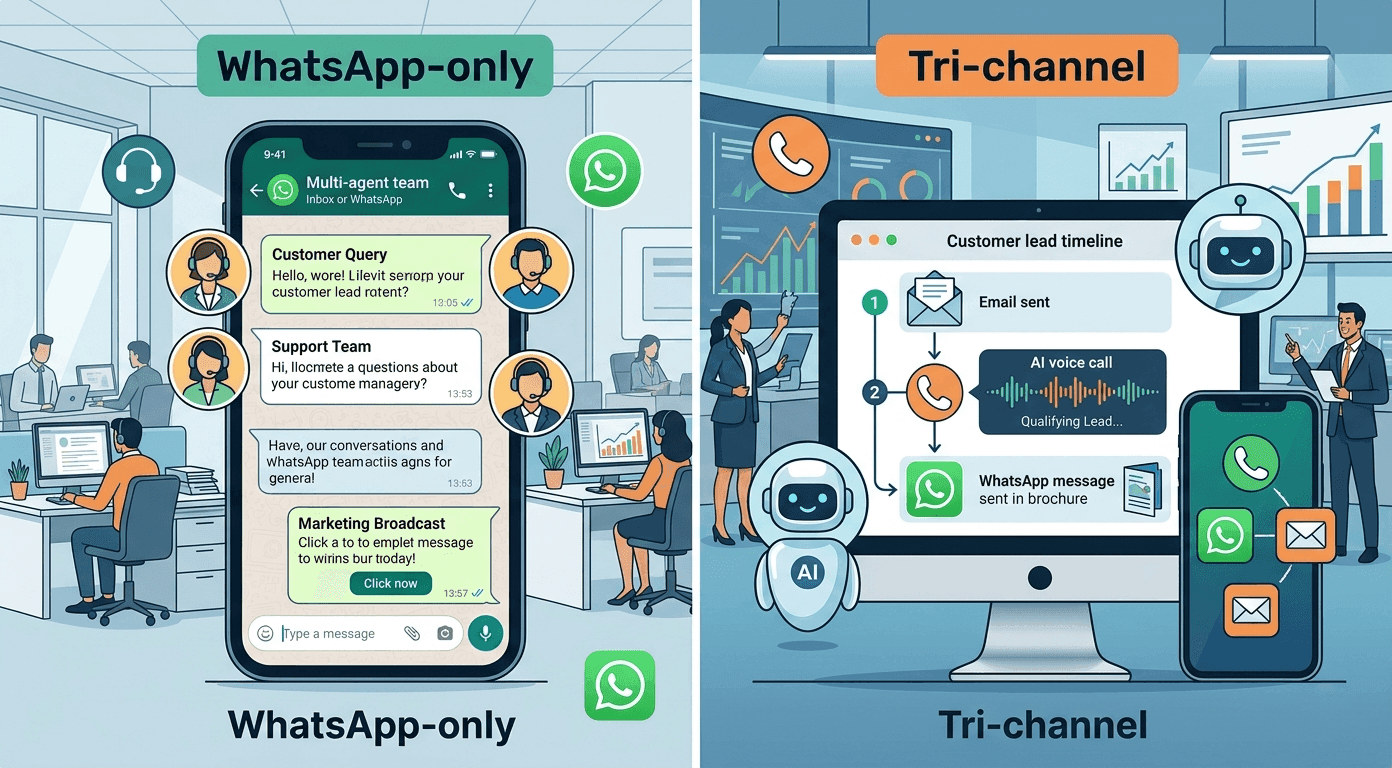
RapidSales vs Wati: WhatsApp Plus AI Calling vs WhatsApp Only
In the Indian business ecosystem, WhatsApp is no longer an optional channel—it is the default. Whether you are a D2C brand handling thousands of orders or a B2B firm qualifying enterprise leads, your customers are on WhatsApp.
This dominance has led to a surge in specialized software. Wati has long been a household name in India, providing a robust interface for the WhatsApp Business API. But as sales teams face higher competition and lower reply rates, a new question has emerged: Is a WhatsApp-only strategy enough?
Enter RapidSales, a platform that argues the future of sales isn't just about messaging—it’s about the seamless orchestration of WhatsApp, AI Voice, and Email. In this guide, we compare RapidSales vs Wati to help you decide which tool fits your sales goals in 2026.
Wati: The King of Inbound WhatsApp Support
Wati (WhatsApp Team Inbox) is a powerhouse designed for one specific purpose: making WhatsApp a collaborative communication channel. It excels at managing the "inbound" flow.
If your marketing team runs a massive Facebook ad campaign that drives thousands of people to "Click to WhatsApp," Wati is an exceptional tool to manage those conversations. It offers a clean shared inbox, a no-code chatbot builder for FAQs, and robust broadcast features for marketing newsletters.
However, Wati is inherently reactive. It is built for support and marketing engagement. It assumes the customer is already in the chat window.
RapidSales: The Evolution of Tri-Channel Outbound Sales
RapidSales takes a fundamentally different approach. It is an outbound sales engine first.
RapidSales recognizes that in high-ticket B2B, Real Estate, or D2C, a WhatsApp message is often ignored if it isn't preceded or followed by a human-like voice conversation. RapidSales doesn't just give you a WhatsApp inbox; it gives you a Tri-Channel AI SDR.
It orchestrates a unified campaign where AI voice agents (fluent in Hindi, English, and Hinglish) call the prospect, qualify them, and then instantly follow up on WhatsApp with brochures or payment links. It is proactive, multi-channel, and built for closing, not just chatting.
Key Feature Comparison: Beyond the Chat Window
1. Inbound Support vs. Proactive Outbound
- Wati: Best for support teams. It handles inbound queries, organizes them with tags, and allows multiple agents to reply to one customer.
- RapidSales: Best for sales teams. It is designed to take a raw lead list (CSV) and "hunt" for interest across Voice, WhatsApp, and Email until a "Smart Handoff" is achieved.
2. Chatbots vs. Conversational AI Voice SDRs
- Wati: Uses "Flow Builders" to create button-based or keyword-based chatbots. These are great for "Track my order" or "Check price," but they cannot "sell."
- RapidSales: Features hyper-realistic AI Voice Agents. These agents don't just follow a button-tree; they have real-time conversations. They handle objections on a phone call, understand regional accents, and build a level of trust that a text-based chatbot simply cannot replicate.
3. Isolated Messaging vs. Tri-Channel Orchestration
- Wati: If your prospect doesn't reply on WhatsApp, the journey ends there.
- RapidSales: Features Cross-Channel Intelligence. If a WhatsApp message remains unread for 4 hours, RapidSales can automatically trigger an AI Voice call to check in. This "omnichannel presence" drastically increases lead qualification rates.
Solving the Indian RTO Crisis: Why Voice Wins
For Indian D2C brands, the comparison between RapidSales and Wati often comes down to Return to Origin (RTO).
Wati allows you to send a WhatsApp message to verify a COD (Cash on Delivery) order. The problem? Buyers often ignore these texts or click "Confirm" without intent.
RapidSales solves this via Voice Verification. The AI agent calls the customer: "Namaste, aapne ₹2,000 ka order place kiya hai, kya hum ise dispatch kar dein?" A verbal confirmation in a native language carries significantly more weight and intent than a button-click. Brands using RapidSales for voice-based verification see a much sharper drop in RTO rates than those relying on WhatsApp-only prompts.
Pricing Economics: Subscription vs. Consumption
The way you pay for these tools reflects their utility.
Wati Pricing: Usually involves a monthly subscription fee plus per-user seat costs, on top of Meta's standard conversation charges. This creates a fixed overhead for your team.
RapidSales Pricing: Focuses on a usage-based consumption model. You can have unlimited users on the platform. You only pay for the actual AI voice minutes, WhatsApp messages, and emails your campaign consumes. This is highly favorable for startups that need to scale their outreach up and down based on lead flow.
RapidSales vs Wati: Head-to-Head Comparison Table
The Verdict: Which Platform Should Your Team Choose?
When to Choose Wati
Choose Wati if your primary goal is Customer Support and Inbound Marketing. If you have a high volume of customers messaging you for status updates, basic queries, or if you want to send weekly newsletters to a warm subscriber list, Wati’s dedicated focus on the WhatsApp interface is excellent.
When to Choose RapidSales
Choose RapidSales if your goal is Proactive Sales and Lead Qualification. If you are a B2B firm, a Real Estate developer, or a D2C brand struggling with RTO, you need more than just a chat window. RapidSales provides the "Voice" component that is essential for building trust in the Indian market, combined with the safety of the official WhatsApp API.
Conclusion
Wati is a brilliant tool for managing a single channel. But in 2026, sales is a multi-channel sport. Relying on WhatsApp alone is like trying to close a deal with one hand tied behind your back.
By upgrading to a tri-channel platform like RapidSales, you ensure that every lead is pursued with the persistence of an AI SDR across Voice, WhatsApp, and Email. Stop waiting for them to reply to your text—give them a call.
Ready to see the power of Tri-Channel AI? Book a Demo Now and automate your sales closing.