What Is an AI SDR? How AI Sales Agents Work in 2026
For the last decade, the B2B sales playbook was entirely reliant on volume and human capital. If a company wanted to double its pipeline, it had to double its headcount of Sales Development Representatives (SDRs). These reps would spend 85% of their days doing grueling, repetitive work: scraping databases, guessing email addresses, writing follow-ups, and dialing hundreds of cold numbers just to get one person on the phone.
In 2026, that model is officially obsolete.
The competitive edge no longer belongs to the team with the largest sales floor; it belongs to the team with the smartest automation. Enter the AI SDR.
But what exactly is an AI SDR, and how does it differ from the basic email sequencing tools we’ve used for years? In this guide, we will break down the mechanics of modern AI sales agents and how they are transforming the revenue operations (RevOps) landscape.
What Exactly is an AI SDR?
An AI SDR (Artificial Intelligence Sales Development Representative) is an autonomous software agent designed to execute top-of-funnel sales activities.
Unlike traditional automation tools that simply send pre-written templates on a fixed schedule, an AI SDR uses Large Language Models (LLMs) and Natural Language Processing (NLP) to reason, adapt, and act independently. It can research a prospect, draft a highly contextual message, read the prospect's reply, handle basic objections, and execute a live voice call.
Its primary goal is identical to a human SDR: to turn a cold lead into a qualified meeting for an Account Executive (AE) to close.
The Evolution: Why 2026 is the Tipping Point for AI Sales Agents
We have had "automation" in sales for years, so what makes an AI SDR different today?
The shift lies in the transition from assistive AI to agentic AI.
In the past, a tool might help a human rep write a better email subject line (assistive). Today, an AI sales agent can log into your CRM, identify accounts showing buying intent, enrich the contact data, write the email, send it, read the reply, and book the calendar meeting entirely on its own (agentic).
This leap in autonomy is driven by ultra-low latency audio processing for human-like voice calls, better CRM API integrations, and LLMs that can reliably follow complex conversational guardrails without hallucinating.
Under the Hood: How Do AI Sales Agents Actually Work?
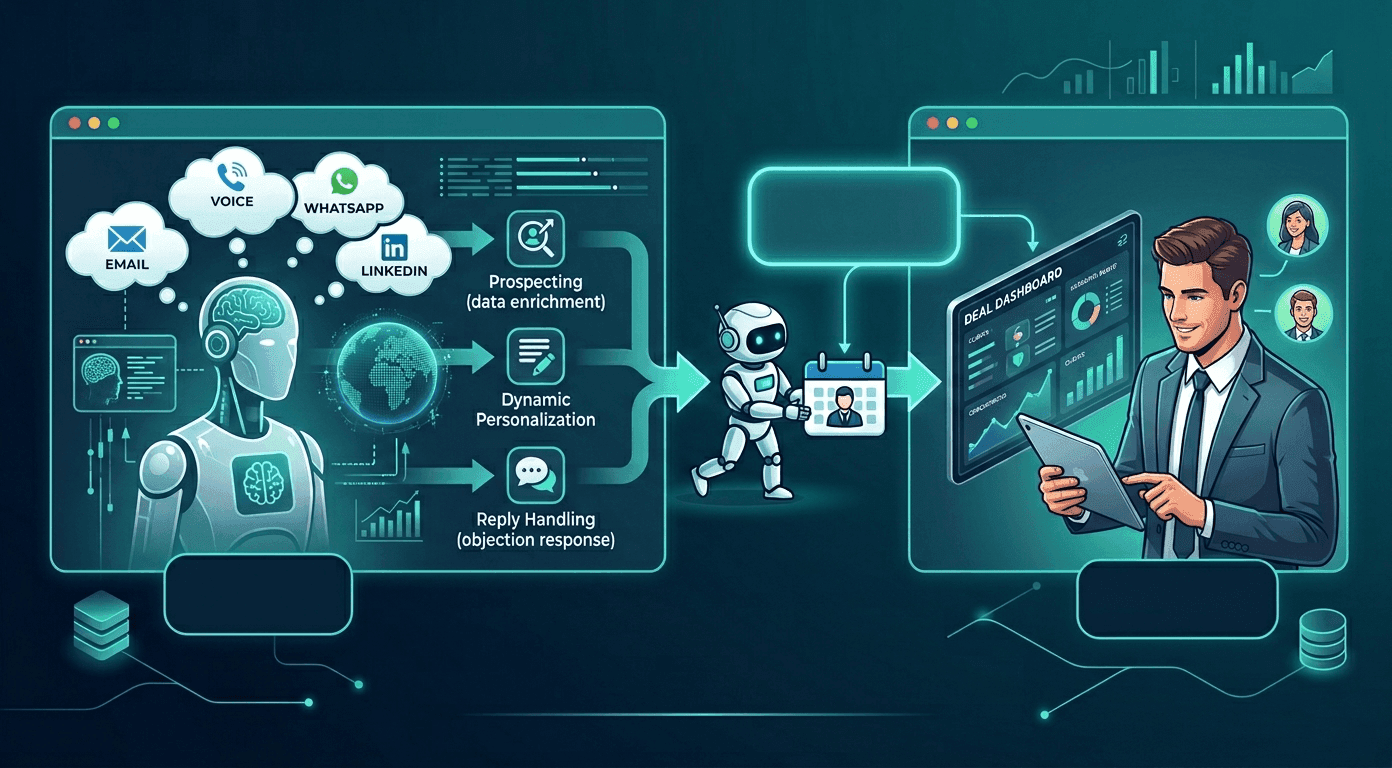
To understand the power of an AI SDR, you have to look at its underlying workflow. Here is how a modern AI sales agent processes a lead from cold to qualified.
Step 1: Autonomous Prospecting & Data Enrichment
An AI SDR does not just blast generic lists. When connected to a data provider or your CRM, the agent scans for your Ideal Customer Profile (ICP). It looks for intent signals—such as a company recently raising funding, a key executive changing jobs, or a prospect visiting your pricing page. The agent then automatically enriches the lead profile with accurate firmographic data.
Step 2: Hyper-Personalized Copy Generation
“Mail merge” personalization (e.g., “Hi [First Name], I love what you are doing at [Company Name]”) no longer works. Buyers see right through it.
Modern AI SDRs use the enriched data from Step 1 to generate hyper-specific messaging. The AI might reference a recent LinkedIn post the prospect wrote, note a specific challenge in their industry, and tailor the value proposition directly to their job title.
Step 3: Tri-Channel Orchestration (Voice, WhatsApp, Email)
Buyers do not live in a single inbox. An effective AI SDR orchestrates outreach across multiple channels seamlessly.
For example, the AI agent might send an introductory email on Tuesday. If the email is opened but ignored, the agent might trigger a WhatsApp message on Thursday. If the prospect is still unresponsive, the AI SDR can initiate a human-like cold call on Friday. The agent coordinates these touchpoints so the outreach feels persistent but natural, not spammy.
Step 4: Intent Scoring & The Smart Handoff
The true magic of an AI SDR is reply handling. If a prospect replies to an email with, "We already use a competitor," the AI understands the sentiment. It can automatically reply with a prepared competitive battlecard or tag the lead as "Nurture."
If the prospect says, "Sounds interesting, let's chat next week," the AI SDR immediately stops all automated outreach. It routes the conversation to a human AE or sends an automated calendar link to book the meeting. This is known as the Smart Handoff.
The Business Impact: Why RevOps Leaders Are Adopting AI SDRs
The adoption of AI sales agents is accelerating because the ROI is undeniable.
Infinite Scalability: An AI SDR can engage with 10 prospects or 10,000 prospects simultaneously with zero drop in personalization quality or response time.
Speed to Lead: When an inbound lead fills out a form, their intent drops drastically within minutes. An AI SDR can respond via email or voice call in under 60 seconds, 24/7.
Cost Efficiency: AI SDRs cost a fraction of a human team's salary, benefits, and software seats. They never take sick days, they don't experience call reluctance, and they never burn out from hearing "no."
Protecting Human Capital: By letting AI handle the grueling rejection of the top-of-funnel, your human sales team avoids burnout and stays energized for the high-leverage task of actually closing deals.
Implementing the "Hybrid Model" with Rapid Sales
The most successful companies in 2026 are not replacing their sales teams with AI; they are adopting a Hybrid Model. They use AI to build the pipeline and humans to close it.
Executing this seamlessly requires a unified platform, which is exactly what Rapid Sales provides.
Rapid Sales acts as your ultimate AI SDR. It doesn't just send emails; it orchestrates intelligent, multi-channel sequences across Email, WhatsApp, and advanced AI Voice calling.
With built-in "Stop on Reply" logic and a 360-degree Unified Lead Timeline, Rapid Sales ensures that the moment a lead shows interest, your human team steps in with full context, ready to close.
Conclusion
The role of the SDR is changing. The days of manual data entry, mindless dialing, and generic email blasting are over. AI sales agents have proven that top-of-funnel pipeline generation can be treated as an engineering problem—one that can be solved with intelligent, autonomous software.
By deploying an AI SDR, businesses can scale their outreach infinitely, ensure no lead ever falls through the cracks, and empower their human sales teams to do what they do best: build relationships and drive revenue.
Ready to stop dialing and start closing? Book a Demo Now and deploy your first AI SDR.