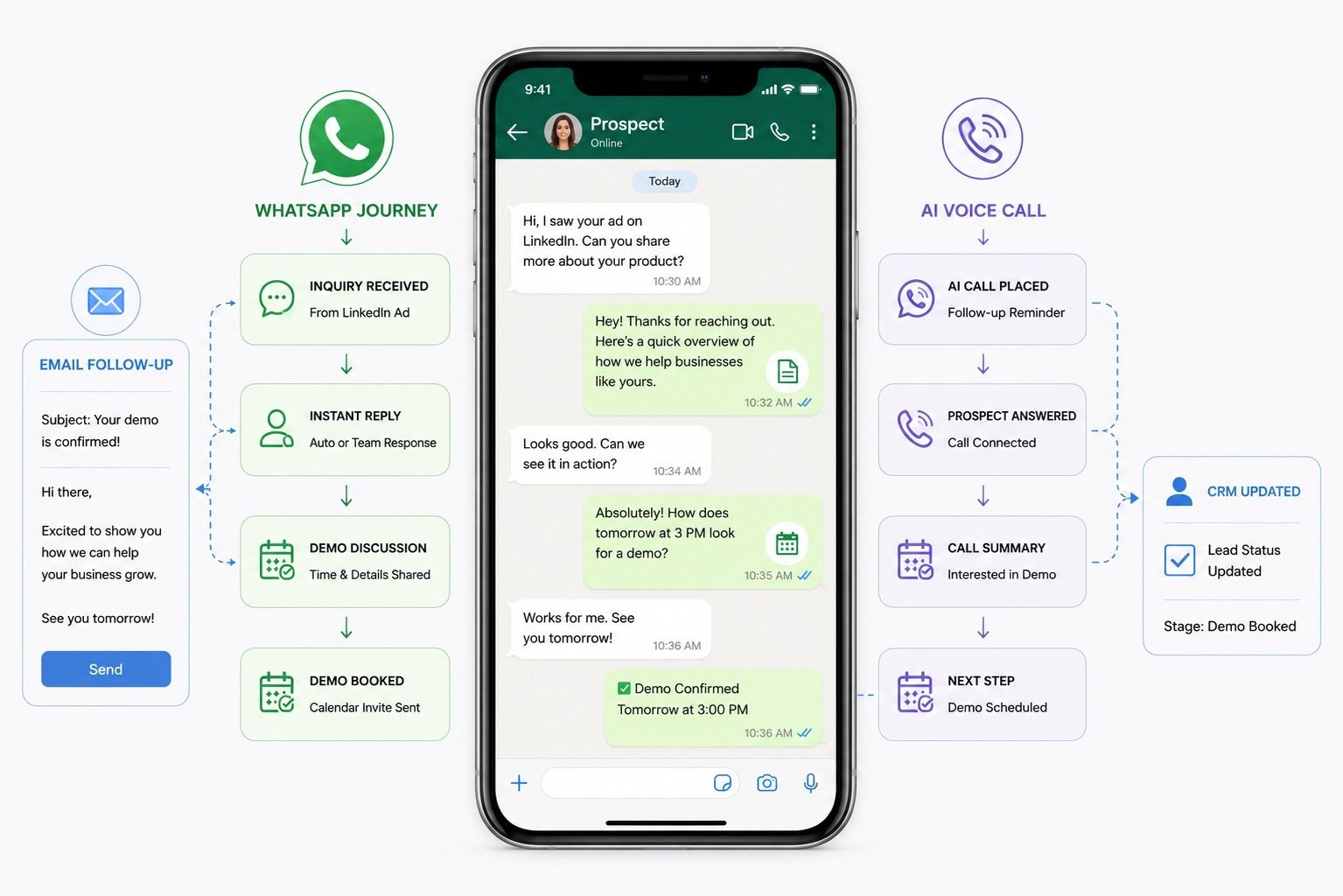
WhatsApp Business Automation: A Blueprint for B2B Sales
What is WhatsApp business automation?
WhatsApp business automation involves using software connected to the WhatsApp API to send scheduled messages, trigger automated replies, and run multi-stage lead nurturing sequences without manual typing. For B2B sales teams, it enables high-velocity lead follow-ups, instantaneous qualification, and immediate appointment booking directly on a prospect's mobile device.
For years, B2B sales organizations viewed WhatsApp purely as an informal channel, leaving it to B2C and direct-to-consumer (D2C) retail brands to utilize. But the communication landscape has shifted. Today's B2B buyers—founders, directors, and procurement leads—want immediate, low-friction answers. They prefer the speed of a text message over the formality of a cold email thread.
However, as B2B teams rush to adopt WhatsApp business automation, they are making a critical structural mistake: they are treating WhatsApp as an isolated silo. This blueprint outlines how to build a high-converting WhatsApp sales strategy that integrates flawlessly into your wider omnichannel CRM.
The Problem with B2B WhatsApp Today: Data Silos
Most businesses approach WhatsApp by purchasing a standalone chat automation software tool. They build basic chatbot workflows to answer FAQs or send broadcast marketing blasts.
In a complex B2B sales cycle, this creates severe data silos. If a prospect asks a technical question on WhatsApp, requests a pricing proposal via professional email, and negotiates terms over a phone call, a fragmented system cannot track that journey. Sales representatives are forced to copy and paste chat histories from their phone into a central database.
This results in poor visibility into customer communication workflows, delayed responses, and lost context. When reps lose context, deals stall.
Beyond Basic Chatbots: The Unified WhatsApp CRM Strategy
To effectively use WhatsApp for B2B sales, it must be upgraded from a standalone marketing tool into a unified sales communication channel. A true WhatsApp CRM strategy means your chat automation works in tandem with your other primary outreach methods.
Integration with Formal Business Email
B2B sales require paperwork. While a prospect may agree to terms over a high-velocity WhatsApp chat, they will still need the final contract, security documentation, and official invoices sent to their corporate email. Your WhatsApp automation platform must native-sync with your email sequences. If a lead requests a document via text, your sales rep should be able to trigger an email template from the exact same dashboard timeline without changing tabs.
Synchronization with AI Voice Calling
Text is fast, but voice builds trust. The ultimate B2B follow-up automation combines automated WhatsApp replies with immediate AI voice calling. When a lead submits a high-value inquiry, an intelligent workflow should instantly send a WhatsApp text confirming receipt while simultaneously triggering an AI call to log preliminary qualification details. Both interactions should immediately be recorded as AI call logs and chat transcripts in the same CRM contact card.
A High-Converting B2B WhatsApp Automation Workflow
How does a professional, non-intrusive B2B sequence look in practice? Here is a core workflow that rapidly accelerates deal momentum:
The Instant Inbound Acknowledgment
A marketing agency owner clicks your Meta ad and fills out an inbound form. Waiting 30 minutes to email them is a guaranteed way to lose their attention. Instead, a WhatsApp business automation rule triggers instantly:
“Hi [Name], thanks for your interest in our automation services. I am reviewing your site now. Do you have 5 minutes later today for a quick strategy chat?”
This establishes an immediate, personal connection with zero manual sales effort.
The Frictionless Demo Booking
If the prospect shows interest, the automation does not send them to a complex, multi-page web form. Instead, it handles demo booking natively within the chat thread. The platform sends a quick link or automated prompt: “Great. Are you available tomorrow at 10 AM or 2 PM?” ### The Smart Stop-On-Reply Engine
This is where standard tools fail and unified systems excel. If you have an automated email sequence running parallel to your WhatsApp outreach, what happens when the prospect replies to your WhatsApp text?
A smart automation system features a built-in cross-channel stop-on-reply engine. The moment the prospect engages on WhatsApp, the system pauses all automated background emails and future chat nudges. This prevents duplicate messaging, ensuring your brand looks highly coordinated and professional.
Metrics to Track in Your WhatsApp Campaigns
To ensure your B2B WhatsApp strategy is driving revenue, you must move beyond basic "open rates." Effective campaign monitoring requires a centralized dashboard that tracks:
- Lead Response Velocity: How quickly your automated system initiates the first WhatsApp touch.
- Multi-Channel Attribution: Did the ad click lead to a WhatsApp chat, an email, or a voice call?
- Meeting Booking Rate: The percentage of automated WhatsApp conversations that convert directly into calendar appointments.
Automate WhatsApp, Email, and Voice with Rapid Sales
Relying on a fragmented mix of single-channel chat apps, separate email platforms, and raw telephony dialers severely limits your sales team's productivity. It causes tool sprawl, increases subscription costs, and leaves critical pipeline data unorganized.
Rapid Sales solves this by providing a unified, highly secure communication management system. With Rapid Sales, businesses can consolidate their entire stack into a single workspace. You can seamlessly manage high-velocity WhatsApp chats and formal business email threads on one chronological timeline, while automatically generating AI call summaries and transcripts for every voice interaction.
Stop juggling isolated chat tools. Automate your WhatsApp, email, and AI calling workflows with Rapid Sales and ensure no business opportunity slips through the cracks.