How to Write a B2B Sales Follow-Up Message That Gets Replies
What makes a good sales follow-up message?
A successful B2B sales follow-up message is concise, context-driven, and devoid of generic filler like "Just checking in." It provides immediate value relevant to the prospect's pain points and concludes with a frictionless, low-effort Call to Action (CTA). Furthermore, the best follow-ups leverage the right channel—using email for formal documentation and WhatsApp for quick, conversational nudges.
“Hi David, just checking in to see if you saw my last email. Let me know when you have time for a quick call!”
If you look at the sent folder of an average B2B sales representative, it is filled with variations of the message above. It is also why their pipeline is filled with prospects who have "ghosted" them.
Modern B2B buyers—founders, directors, and managers—are ruthlessly protective of their time. They receive dozens of sales pitches a day. A follow-up message that provides zero value and asks them to do the heavy lifting of scheduling a call will be instantly deleted.
To boost your reply rates, you must rethink how you write, format, and deliver your sales follow-up messages.
The Death of "Just Checking In"
Phrases like "Just checking in," "Touching base," or "Floating this to the top of your inbox" are selfish. They imply that the only reason you are messaging the prospect is because you want to hit your quota. They offer nothing to the buyer.
Your prospect did not reply to your first message for one of three reasons:
- They didn't see it.
- They saw it but were too busy to reply.
- They saw it and decided your product wasn't valuable enough to warrant a response.
A generic "just checking in" text does not solve any of these issues.
The Anatomy of a Perfect Sales Follow-Up Message
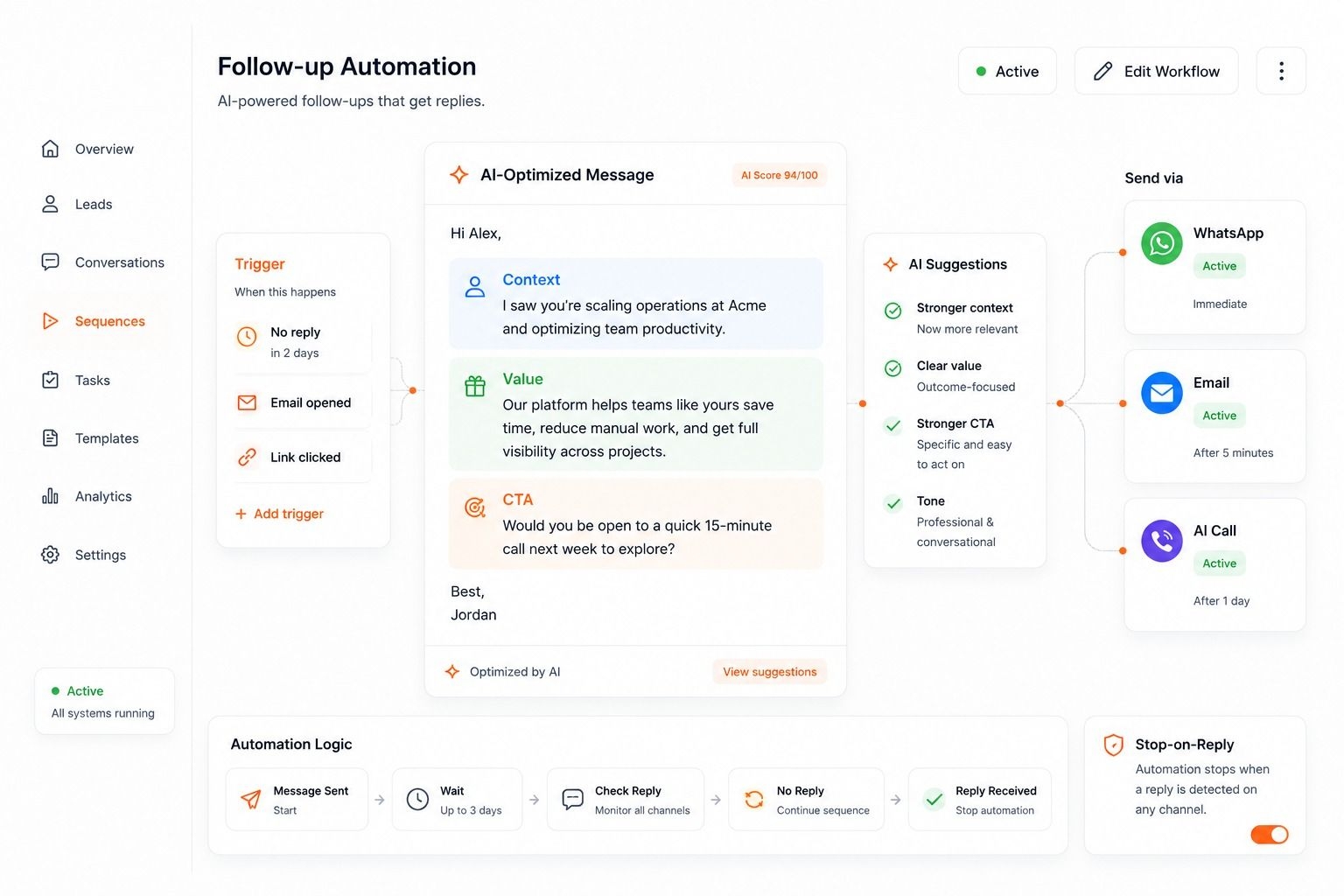
Whether you are writing an email or a WhatsApp message, a high-converting follow-up contains three distinct elements:
1. Context (The Anchor)
Remind them why you are reaching out, but do it in one sentence. Do not make them search their memory.
(e.g., "Hi Sarah, following up on the software demo we had on Tuesday.")
2. Value (The Reason)
Provide a piece of micro-value that is relevant to the problem they are trying to solve. This proves you are a consultant, not just a quota-chaser.
(e.g., "I know your team is struggling with RTO losses. I attached a quick 1-pager showing how a similar D2C brand fixed this last month.")
3. Frictionless Call to Action (The Ask)
Do not ask for a 30-minute meeting in a follow-up. Ask a question that can be answered with a simple "Yes" or "No," or a one-word reply.
(e.g., "Are you still looking to solve this in Q3, or should I pause reaching out?")
WhatsApp vs. Email: Matching the Message to the Medium
In 2026, relying solely on email limits your reach. You must use a multi-channel strategy. However, the tone of a WhatsApp message must be different from the tone of an email.
Email Template: The Formal Value Add
Use email when you need to send case studies, proposals, or formal documentation.
Subject: Resource for [Company Name]'s outbound strategy
Body:
Hi [Name],
We spoke briefly last week about the drop-off in your outbound lead conversions.
I put together a quick 2-minute video audit of your current ad-to-sales funnel, highlighting two areas where leads are leaking. [Link to Video]
Let me know if you’d like me to send over the written breakdown as well.
Best,
[Your Name]
WhatsApp Template: The Velocity Nudge
WhatsApp is built for speed and informality. Keep it under three sentences. Use it to bump an email or ask a rapid qualification question.
Message:
"Hi [Name], I just emailed over that 2-minute video audit of your outbound funnel. Let me know if you want the written breakdown too. No rush to reply!"
The Ultimate "Breakup" Follow-Up Message
If a prospect has ignored three consecutive follow-ups, it is time for the "Breakup" message. This message relies on the psychological principle of loss aversion. By giving the prospect permission to walk away, you remove the sales pressure, which often triggers a response.
Message:
"Hi [Name], I haven't heard back, so I'll assume improving your lead follow-up speed isn't a priority for Q3. I will stop reaching out, but feel free to reply here whenever you are ready to reconnect. Wishing you the best!"
Timing and Automation: Why Manual Follow-Ups Fail
Having the perfect templates means nothing if your execution is slow.
The 60-Second Inbound Rule
If a prospect submits an inbound lead form on your website, your first follow-up message must be dispatched within 60 seconds. Waiting 30 minutes gives them time to contact your competitors. Because humans cannot type that fast, this initial outreach must be automated.
The Importance of "Stop-on-Reply"
If you use automated sequences to send your follow-up templates, you must use a smart CRM. If a prospect replies to your WhatsApp nudge saying, "Thanks, let's talk tomorrow," your system must feature a cross-channel Stop-on-Reply engine. This ensures that the automated email scheduled for the next day is instantly canceled. Nothing destroys buyer trust faster than receiving a robotic follow-up email after they have already agreed to a meeting via text.
Automate Your Sales Follow-Ups with Rapid Sales
Writing great sales copy is an art. Delivering it at the perfect time, across the right channels, without making mistakes, is a science.
Rapid Sales is a unified sales communication platform built to execute perfect follow-ups. Instead of relying on your sales reps to manually remember to send WhatsApp texts and emails, Rapid Sales automates the entire sequence.
You can load your best-performing templates into the CRM, build multi-channel workflows that trigger instantly when a lead comes in, and rely on our native stop-on-reply engine to keep your outreach professional and coordinated.
Stop losing deals to slow, manual follow-ups. Book a Rapid Sales demo today and see how easy it is to automate your multi-channel sales sequences.